In Sochi descendants of the Turkmen leopard released into the wild

The release of four Central Asian leopards to their natural habitat took place at the Caucasus Leopard Recovery Center. Among the Center’s “graduates” are kittens born in 2018 from a male Alous and a female Cheri. Two wild leopards were presented to Vladimir Putin as a gift from the President of Turkmenistan in 2009.
Young carnivores are the offspring of Turkmen and Iranian Front-Asian leopards were born in the Sochi National Park. The nurslings of the Caucasus Leopard Recovery Center feel great and are fully ready for independent life.
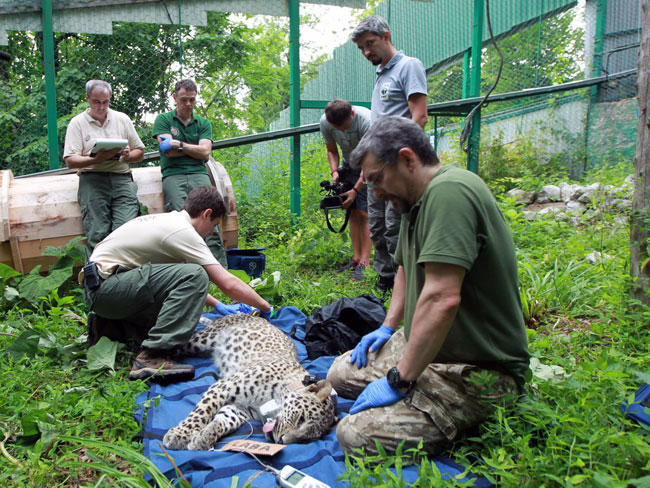
Agura, Aibga and Kodor are under the supervision of specialists of the Russian Academy of Sciences, were tested for hunting skills, psychological stability, and the presence of a persistent reaction to avoiding humans and livestock. All kittens have individual character trait and abilities, so the specialists of the Center develop separate programs for the preparation of each individual.
 All released young predators were put on satellite collars, in order to track the adaptation of leopards in the wild. The leopard recovery program in the Caucasus has no analogues and the entire world conservation community is following its course.
The Central Asian leopard lives on the territory of Turkmenistan. In the 50s, the leopard population gradually began to decline. But thanks to the creation of two mountain reserves in Kopetdag – Syunt-Hasardag and Kopetdag, the situation has improved.
In different years, one day the number of Turkmen leopards has sharply increased and another day – decreased. The predator population was divided into small groups. And in some areas, the leopard has disappeared completely. But this large cat is an important link in the ecosystem of nature, and the disappearance of the leopard can destroy a lot.
All released young predators were put on satellite collars, in order to track the adaptation of leopards in the wild. The leopard recovery program in the Caucasus has no analogues and the entire world conservation community is following its course.
The Central Asian leopard lives on the territory of Turkmenistan. In the 50s, the leopard population gradually began to decline. But thanks to the creation of two mountain reserves in Kopetdag – Syunt-Hasardag and Kopetdag, the situation has improved.
In different years, one day the number of Turkmen leopards has sharply increased and another day – decreased. The predator population was divided into small groups. And in some areas, the leopard has disappeared completely. But this large cat is an important link in the ecosystem of nature, and the disappearance of the leopard can destroy a lot.
 At present, the number of Front-Asian leopards on Earth is extremely low. Due to the deplorable situation in a number of countries, everything possible is being done to restore the predator population.
One of the largest populations of leopards is in Iran, but the Central Asian leopard also lives in Turkey, Azerbaijan, Afghanistan and Turkmenistan. Once upon a time, the leopard was widely distributed in the Caucasus, but only a few individuals were preserved due to mass poaching.
In 2005, the Leopard Recovery Program in the Caucasus was developed by WWF Russia experts together with scientists from the Institute of Ecology and Evolution. Every year, the Recovery Center was replenished with large cats brought from different countries. In August 2013, the first kittens were born, including two leopards from a Turkmen male and an Iranian female.
At present, the number of Front-Asian leopards on Earth is extremely low. Due to the deplorable situation in a number of countries, everything possible is being done to restore the predator population.
One of the largest populations of leopards is in Iran, but the Central Asian leopard also lives in Turkey, Azerbaijan, Afghanistan and Turkmenistan. Once upon a time, the leopard was widely distributed in the Caucasus, but only a few individuals were preserved due to mass poaching.
In 2005, the Leopard Recovery Program in the Caucasus was developed by WWF Russia experts together with scientists from the Institute of Ecology and Evolution. Every year, the Recovery Center was replenished with large cats brought from different countries. In August 2013, the first kittens were born, including two leopards from a Turkmen male and an Iranian female.
Selbi CHARYEVA


