



Ashgabat's cultural scene is increasingly dominated by a name that defies the usual stereotypes of modern teenagers. Jeyran Ismailova manages to combine the image of a serious pianist with the spontaneity of an ordinary teenager.
Looking at her, you can't help but wonder: how does this fragile person manage to combine the steely discipline of a classical musician with a keen interest in a world that embraces both the French language and ABBA's hits? We decided to interrupt her rehearsals and discover what lies behind her piano passages and focused gaze on stage.
-Jeyran, you've been playing the piano since you were five. Do you remember the moment when the piano stopped being just a part of your curriculum and became your personal way of communicating with the world? And let's be honest: have you ever felt like just slamming the lid, declaring a musical holiday, and going for a walk? How do you cope when the workload gets too much?
-You know, music has become a natural background for me, like breathing. I honestly can't imagine anything else that could captivate me as much. But I'm just an ordinary person, and of course, there are days when I want to drop everything and just go for a walk, not thinking about notes at all. At those moments, I don't force myself to practice. My best medicine is a scoop of ice cream and a good movie. It helps me recharge, and then the desire to play returns naturally. Music should bring joy, not be a chore.
-You're learning French, a language considered one of the most melodic in the world. Does this help you hear the music of Debussy or Ravel in a special way? Do you feel a connection between the softness of their native language and the music they wrote for the piano?
-When you play the works of Claude Debussy or Maurice Ravel, you sense the language within the music—its softness, refinement, and unique melody. Learning French really helps you grasp these intonations. You begin to understand the nature of this beauty from within, hearing nuances that might have previously eluded you. It's like an additional instrument: the music acquires the correct "pronunciation," becoming more alive and comprehensible on a sensory level. French composers are very demanding of detail, and knowing the language helps me convey that atmosphere without unnecessary pathos, simply through the senses.
— Do you have any favorite Turkmen composers?
— Of course, our classics—Nury Khalmamedov, Chary Nurymov, Durdy Nuryev. I really love and appreciate the work of contemporary composers. And one of them is Aina Shirova. Her compositions are innovative; she has her own signature style and uniqueness. She's not afraid to experiment. She was the first in Turkmenistan to organize interactive composer games. She is the author of the first works in the instrumental theater genre in Turkmenistan. These are works where the musician performs music and simultaneously performs pantomime, a kind of one-man mini-theater. And I was honored to be the first to perform Aina Shirova's entire cycle of plays in this genre.
-Music competitions are always a nerve-wracking experience. What do you think about when that ringing silence descends on the hall, and you're just raising your hands over the keys? Do you have a personal secret or ritual that helps you stay calm in front of the judges?
-I don't have any talismans or special rituals for good luck. I believe that simple concentration is enough. In those seconds of silence before the start, I think about the upcoming "conversation." This is the moment when you're about to say something very important to the audience—wordlessly, but with great sincerity. Stress melts away when you realize that your task isn't just to press the keys, but to convey a message to those who have come to hear you. Concentration displaces fear. On stage, you're alone with the music, and if you're completely immersed in it, the hall's silence ceases to oppress you.
-If we had a time machine and a free evening, which composer would you visit for tea? Which of the greats do you think would be the most suitable for a heart-to-heart talk?
-It would definitely be Frédéric Chopin. His music is closer to my heart: it has grace, calm, and depth that is simultaneously calming and deeply touching. I think Chopin was an amazingly subtle person, and I would be incredibly interested simply to be in his company, to experience the atmosphere in which he created. I would love to hear how he interprets his own works, because the composer's vision is always the key to understanding music. His sincerity in every note is something I want to study endlessly.
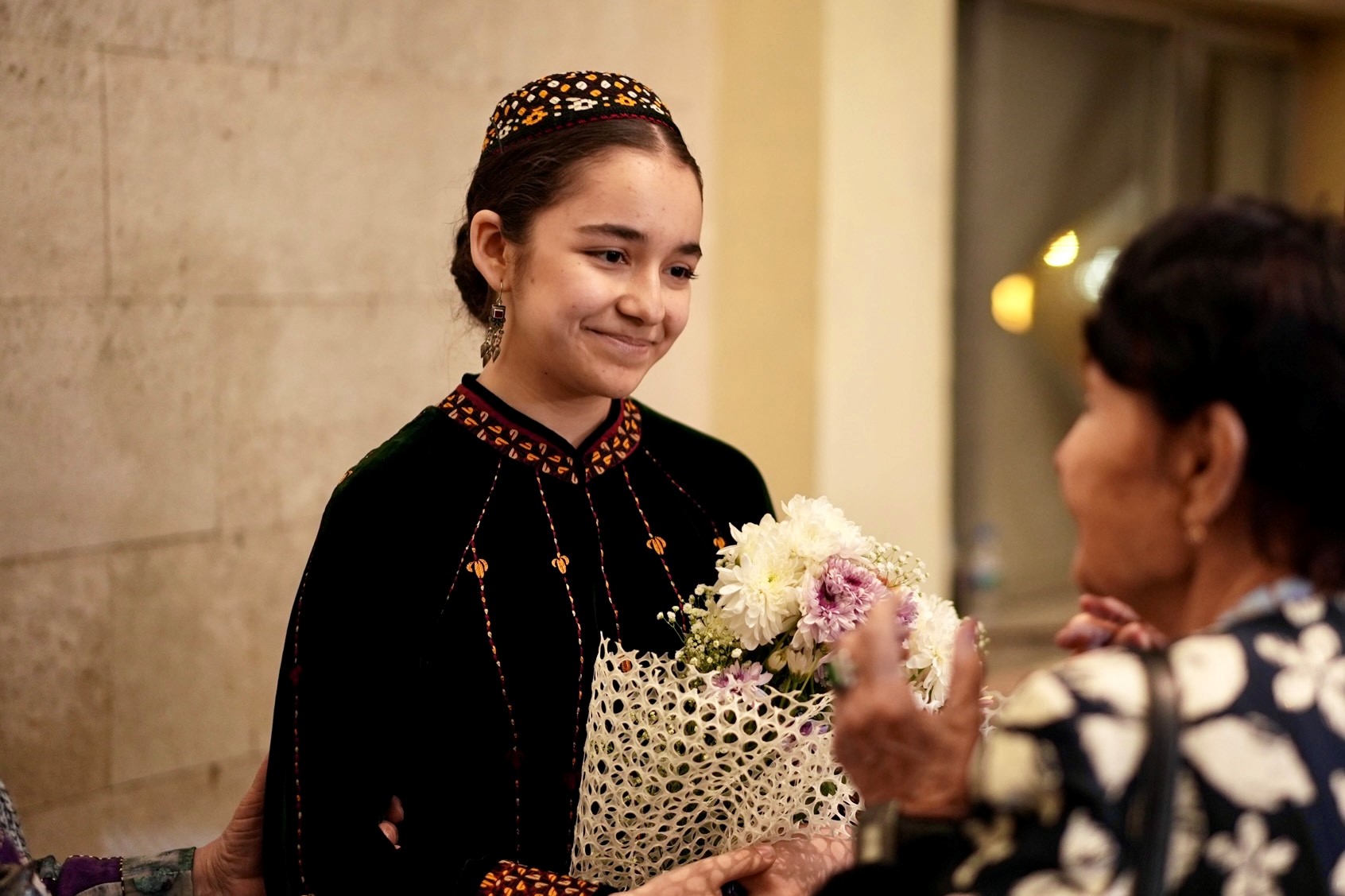
-Ashgabat is a sunny and very warm city. If you had to describe its character through music, what tempo and instrument would you use? How strongly do you connect with your roots in your work?
-If I were to describe Ashgabat through music, it would definitely be the dutar. Its sound captures the soul and life of our people. It's the breath of the era, permeating the music, and it touches everyone—both the elderly and the young. It provides a certain grounding and helps you experience the music more deeply. Every piece I play contains a piece of this light and warmth of our city.
-Let's take a look at your playlist. What do you listen to in your headphones in everyday life? Is there anything far from classical? And how do you feel about the idea that a modern musician needs to be a bit of a blogger?
-Right now, I'm listening to ABBA and their "Dancing Queen." I love all kinds of music, as long as it's high-quality and puts me in a good mood. Limiting myself to just classical music would be wrong; the world of art is much broader. As for social media, I think it's important for a modern musician to be a bit of a blogger. And this is necessary not so much for popularity, but to find "your" people and expand the boundaries of your music. Social media helps show that classical music isn't boring and can be interesting to my peers.
-Imagine waking up tomorrow in Paris. Where would you most like to perform—on the stage of the legendary Grand Opera or on an old piano in a cozy street café?
-Of course, the Grand Opera. It's every artist's dream. Performing on such a historic stage is an incredible achievement, a symbol of mastery one strives to achieve. It's a place with such a powerful history that just being there makes your heart beat faster. Street cafés in Paris are very romantic and atmospheric, but for a professional musician, a stage as grand as the Grand Opera remains the ultimate goal and dream.
-Diplomas aside, what do you consider your greatest personal victory to date?
-My greatest victory is my parents and my teachers, who believe in me. Thank them so much! Without their support, patience, and faith in my abilities, no diplomas or medals would be meaningful. Knowing that there are people around you who will support you in moments of triumph and in moments of fatigue is my greatest success. This faith gives me the strength to move forward.
— What advice would you give to your peers who are sitting around sighing because they're "already fifteen" and it's supposedly too late to start studying?
— If you have the desire, there's no need to make up reasons why "it won't work out." You just need to start and take that first step. Age isn't an argument at all if you're truly passionate about what you're doing and are willing to invest your time and heart into it. It's never too late to try something new and follow your dreams. The main thing is to believe in yourself and not be afraid of the challenges at the beginning.
— And finally: if a biopic were made about your life now, what music should play over the end credits?
— At the very end of such a film, during the end credits, La Maritza would definitely be played. It perfectly captures my current state—the lightness, hope, and inner energy with which I look to the future.
Anay Yolbarsov
