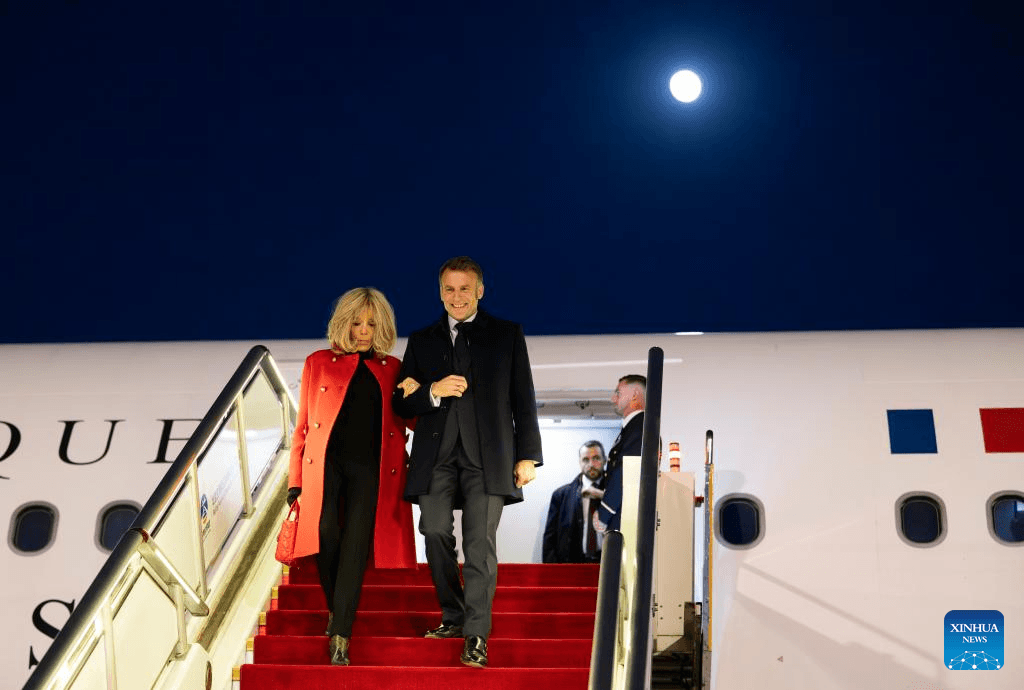
On the invitation of President of China Xi Jinping, French President Emmanuel Macron has arrived in Beijing for a state visit, according to China Central Television (CCTV), the country's main state broadcaster.
The visit will last until Friday and is already the fourth for the French leader. It is a reciprocal move to Xi Jinping's state visit to France last year, which was timed to the 60th anniversary of the establishment of diplomatic relations between the two countries.
An important historical detail, creating a special political context, is the fact that France was the first major Western country to establish diplomatic relations at the embassy level with the People's Republic of China. This circumstance invariably lends additional depth and symbolic significance to bilateral ties.
The main focus of this visit will be an exchange of views between the two leaders on key international and regional issues, as well as identifying priorities for the further development of Chinese-French relations in the rapidly changing global environment.
The parties are expected to focus on developing coordinated approaches to the modern system of international relations, which is particularly important given the status of China and France as permanent members of the UN Security Council. The French delegation includes Foreign Minister Jean-Noël Barrot, other high-ranking officials, and representatives of the business community. This underscores Paris's intention to make the visit comprehensive, combining political, economic, and diplomatic aspects.
According to CCTV experts, under the strategic leadership of the two heads of state, contacts at all levels have intensified in recent years, practical cooperation has become more fruitful, and coordination on multilateral issues has become more robust. Therefore, the current visit is perceived as an opportunity to inject additional momentum into new agreements and strengthen strategic understanding between the two countries.

Contacts prior to Macron's visit were also significant. Six days before his arrival, Chinese Foreign Minister Wang Yi, also a member of the Politburo of the Communist Party of China, held a telephone conversation with Emmanuel Beaune, diplomatic adviser to the French president.
The Chinese side expressed hope that Paris would encourage the European Union to develop a more positive and rational approach toward China. France, for its part, reaffirmed its commitment to the tradition of an independent foreign policy, reiterated the immutability of the one-China principle, and emphasized its understanding of Beijing's legitimate position on the Taiwan question.
In Beijing, Wang Yi held talks with French Foreign Minister Jean-Noël Barrot. During the meeting, the Chinese diplomat noted that high-level contacts between China and France have always been a focus of the international community, especially given the increasingly complex global situation.
Wang Yi emphasized that both countries, as the victorious powers of World War II and permanent members of the UN Security Council, need to strengthen cooperation and jointly uphold the fundamental principles of the post-war international order. He also outlined the People's Republic of China's position on the Japanese leadership's recent statements on the Taiwan question. "China hopes and believes that France will continue to understand and support its legitimate position," Wang Yi added.
Barrot reaffirmed President Macron's strong commitment to relations with China. France reiterated its commitment to the one-China policy, expressed its desire to strengthen friendship between the two peoples, and emphasized its readiness to promote constructive dialogue between the European Union and China.
The French Foreign Minister thanked the Chinese side for its active efforts in organizing the visit and expressed confidence in its fruitfulness. Paris also reaffirmed its commitment to the idea of an independent and autonomous European Union, which makes engagement with China particularly important in a rapidly transforming international environment.
CCTV notes that Macron's visit to Beijing is taking place in the context of important global diplomatic events. Next year, France will host the G7 summit, and China will chair the 33rd APEC Economic Leaders' Meeting. Under these circumstances, strengthening coordination between Paris and Beijing on global governance issues takes on particular importance. From the climate agenda to the reform of international institutions, the range of topics on which France and China are seeking to align their positions is expanding, reflecting the growing interdependence of international processes.
Against this backdrop, Emmanuel Macron's state visit to China is viewed by both sides as an opportunity to inject new impetus into bilateral cooperation, strengthen strategic mutual trust, expand practical partnerships, and deepen collaboration on global and regional security issues.
The two countries' joint efforts are expected to make an important contribution to the development of the Sino-French strategic partnership and the formation of a more resilient architecture of international relations.
ORIENT