We are guided by what unites people




News
Articles
Media
Announcement
 Chinese New Year
Technology
About Us
Contacts
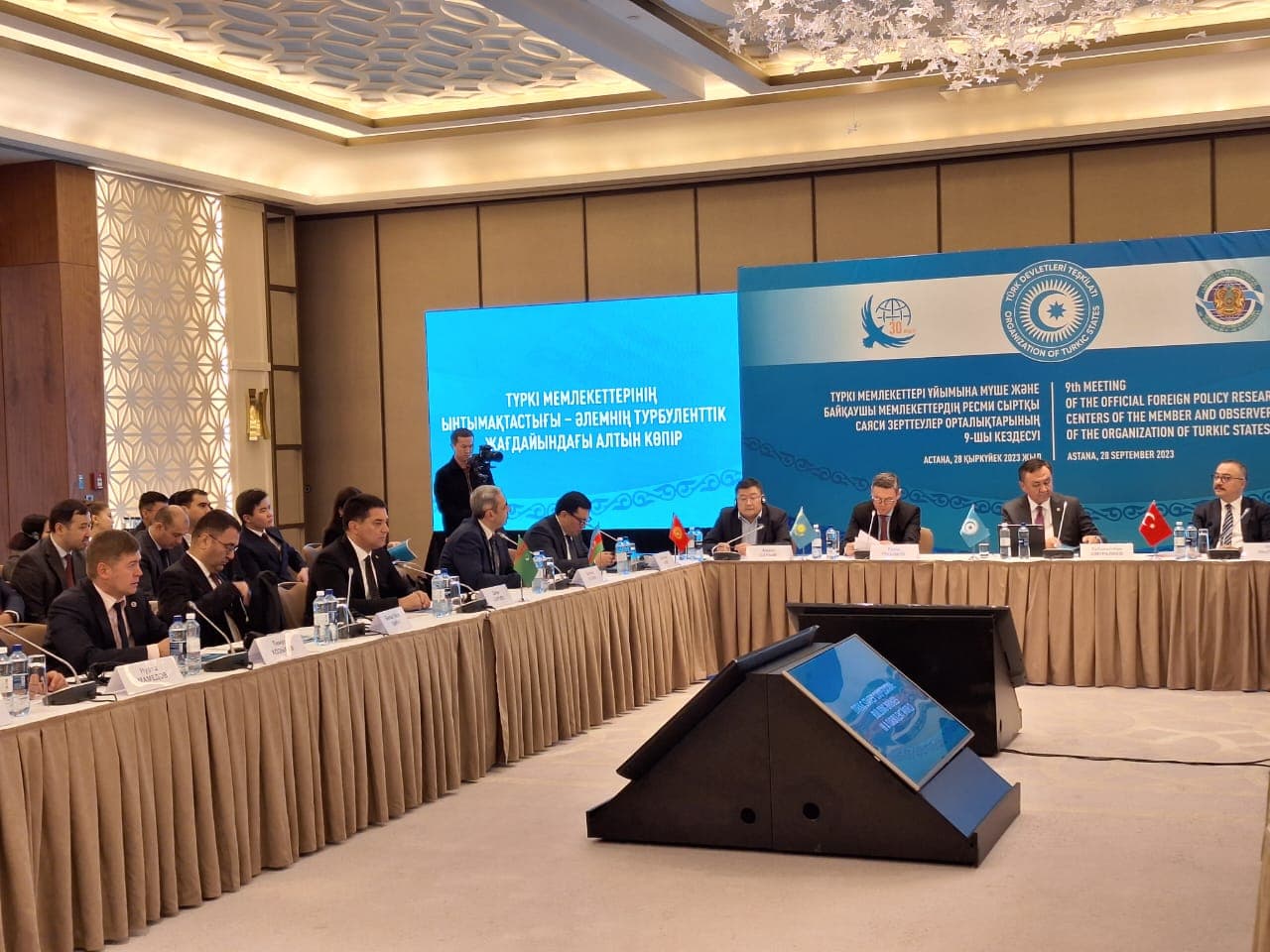
Chinese New YearThe meeting of the official centers of foreign policy studies of the member countries and observers of the Organization of Turkic States is taking place on Thursday, September 28, in Astana, on the eve of the Summit of the leaders of the OTG. Turkmenistan is represented at the forum by the leadership of the Center for Strategic Studies of the Institute of International Relations of the Ministry of Foreign Affairs.
At the opening of the annual meeting of experts, which this year is being held for the 9th time, under the title "Cooperation of the Turkic states: building bridges and dialogue in a turbulent world", the Secretary General of the OTG Kubanychbek Omuraliev made a welcoming speech.
Then a plenary session was held, which focused on the features of the regional model of interaction in the era of the global crisis of trust.
Director of the IMO Center for Strategic Studies of the Ministry of Foreign Affairs of Turkmenistan Shiri Shiriev, addressing colleagues, focused attention on the fact that the states participating in this organization represent a vast geographical space in central Asia and have geo-economic advantages, being in the nodal sections of transport and transit corridors, in the East-West and North-South directions.
The attractive effect of OTG in the broad international arena is expressed by a number of important dimensions, he noted.
Firstly, the OTG is not a political or military alliance. This organization is exclusively a platform for partnership based on common historical roots, culture, coincidence of trade and economic interests.
Secondly, OTG provides a good opportunity for investment activities, technical and technological partnership and exchange of "know-how", education and training of personnel, development of human capital in general. This is evidenced

by the presence of a potential market with a population of more than 170 million people and a territory of almost four million square kilometers.
Thirdly, the geographical space of the OTG makes it possible to effectively use its trade and transit opportunities. Each of the participating states today is capable of becoming a major logistics center, and in total it is possible to form an entire infrastructure of "hubs" through which goods can be transported between Asia and Europe. The expansion of cooperation contributes to the rapid and cost-effective transportation of hydrocarbon resources to the consumer countries.
To all this is added the fact that the member States of the OTG are fraternal peoples with a centuries-old history. The unifying factors are not only a common ethnic identity, spiritual values and traditions, but also history, geography, economy and information space.
President of Turkmenistan Serdar Berdimuhamedov, in his speech on September 19, 2023 at the plenary session of the 78th session of the UN General Assembly, stressed that: "For many reasons, the current world is facing a number of very serious challenges. With the difference in their manifestations, all of them to a greater or lesser extent affect the course of interstate relations, often negatively affect the implementation of agreed development plans and programs in key areas of the global agenda."
In this regard, the Head of Turkmenistan, as part of joint efforts, put forward the initiative to create a format for a Meeting on security in Central Asia and adjacent zones under the auspices of the UN. The purpose of the Meeting is to develop approaches and solutions aimed at bringing together and synchronizing the efforts of the Central Asian countries and the world community, international organizations, financial and economic institutions in ensuring sustainable, conflict–free development of this region.
In this regard, Shiri Shiriev called on the heads of analytical centers to support this initiative on the part of OTG, as an organization able to give a worthy response to modern challenges related to the preservation of peace and stability, water, environmental and food security, to unite efforts in the fight against international terrorism, organized crime and extremism.
The conceptual basis for the Turkmen side is consistent adherence to the principle of indivisibility of security, its integrity, and the inseparability of its various aspects from each other, he stressed. In this context, the national, regional and global levels of security form an integral system, combining military-political, economic, water-ecological, energy, technogenic, transport and transit, food, biomedical, cultural and informational and other interrelated components.

There are no secondary, irrelevant or deferred aspects among them. All of them require priority attention today.
From this point of view, Turkmenistan considers the modern UN platform with all its "pros" and "cons" as a system-forming basis for stable international relations, taking into account existing views on the reforms of the Community of Nations.
An integral vision of regional and global problems contributes to the formation of a holistic approach to solving long-term and strategic tasks, including those related to OTG, Shiriev said. In his opinion, it is important here to ensure exactly such an integral approach to the problem of peace, security and sustainable development, jointly implement the experience, competencies, ideas and initiatives available to our states in a creative way, move away from momentary benefits and advantages in order to achieve truly fateful goals.
Since Turkmenistan joined the OTG as an observer country, we have been advocating for the Organization to become an effective mechanism for influencing political events in the world, Shiriev stressed. This thesis was again voiced at the last Samarkand summit of the OTG countries by Chairman of the Halk Maslahaty Gurbanguly Berdimuhamedov, who was invited there as an honorary guest.
Turkmenistan proceeds from the need to consistently consolidate the efforts of States to achieve the main strategic goal - ensuring universal stability and security in decision-making through strict compliance with the norms of international law and the UN Charter.
In the same place in Samarkand, the Afghan issue was also identified as an integral part of cooperation in the field of regional security, due to the fact that some
member countries of the OTG are neighbors of Afghanistan, have a special historical connection and legitimate interests with it. Therefore, to a certain extent they are also responsible for the events taking place in this country.

In this context, special attention was focused on the need to step up efforts aimed at stabilizing the situation in Afghanistan and creating conditions for achieving national accord through the provision of economic and humanitarian assistance to the Afghan people.
One of the urgent tasks of the OTG for the foreseeable future should be the timely use of the competitive advantages of the Organization to ensure the role of a full and effective participant in the formation of new transport and transit corridors and energy routes, said Shiri Shiriev.
He also added that the adopted Concept of "Turkic Global Vision 2040" fits perfectly into the international paradigm and considers the Turkic project as one of the elements of a new improved world order. The authors of the Concept call for the creation of an international system that serves equally "the well-being of all countries" and "the spread of universal values." Moreover, the participants of the OTG believe that one of the main tasks is to "contribute to the development of comprehensive inclusive global governance", meaning by this the reforms and revitalization of the UN.
Ideologically neutral approach causes additional attractiveness of the OTG as a practically oriented project, the Director of the CSI IMO of the Ministry of Foreign Affairs of Turkmenistan stressed, pointing out that most of the project "Turkic Global Vision 2040" is devoted to practical interaction in such areas as transport, energy, science and education, technology, space, medicine, tourism, media, youth cooperation.
The current level of dialogue between the OTG countries is the result of long-term work on the development of political and economic cooperation, mutual understanding and the search for consensus, he said.
In a concentrated form, the experience of our communication shows that the Organization of Turkic states at the present stage is able to form an effective
mechanism for building regional and global platforms to stimulate the growth of mutual well-being, strengthening peace and stability, summed up Shiri Shiriev.

The working program of the meeting of the heads of the Centers for Foreign Policy Studies of the OTG member countries and observers also included sessions entitled "OTG in the face of challenges to international and regional security" and "Fundamentals of Turkic cooperation: economic projects and cultural and humanitarian cooperation". This part of the meeting is an expert discussion in the format of an active exchange of opinions and views, questions and answers on the most burning topics on the agenda of the OTG.
In general, analysts agree that the growth of international conflict and tension, as well as the violation of established trade and logistics routes, contribute to strengthening the consolidation of small and medium-sized states, including the countries participating in the OTG.
OTG is a strategically important foreign policy vector, contributing not only in terms of increasing the transport potential of the "Middle Corridor", but also in promoting the idea of preserving the stability of the international situation and the geopolitical neutrality of the foreign policy of the participating countries.
Among the participants of the meeting of the heads of the official centers of foreign policy studies of the member countries and observers of the OTG are seven institutes: the Kazakhstan Institute for Strategic Studies under the President of the Republic of Kazakhstan, the Center for Analysis of International Relations of Azerbaijan, the Hungarian Institute of International Relations, the National Institute for Strategic Studies under the President of the Kyrgyz Republic, the Center for Strategic Studies under the Ministry of Foreign Affairs of the Republic of Turkey, the Center for Strategic Studies of the Institute of International Relations relations of the Ministry of Foreign Affairs of Turkmenistan, Institute of Strategic and Interregional Studies under the President of the Republic of Uzbekistan.
ORIENT news