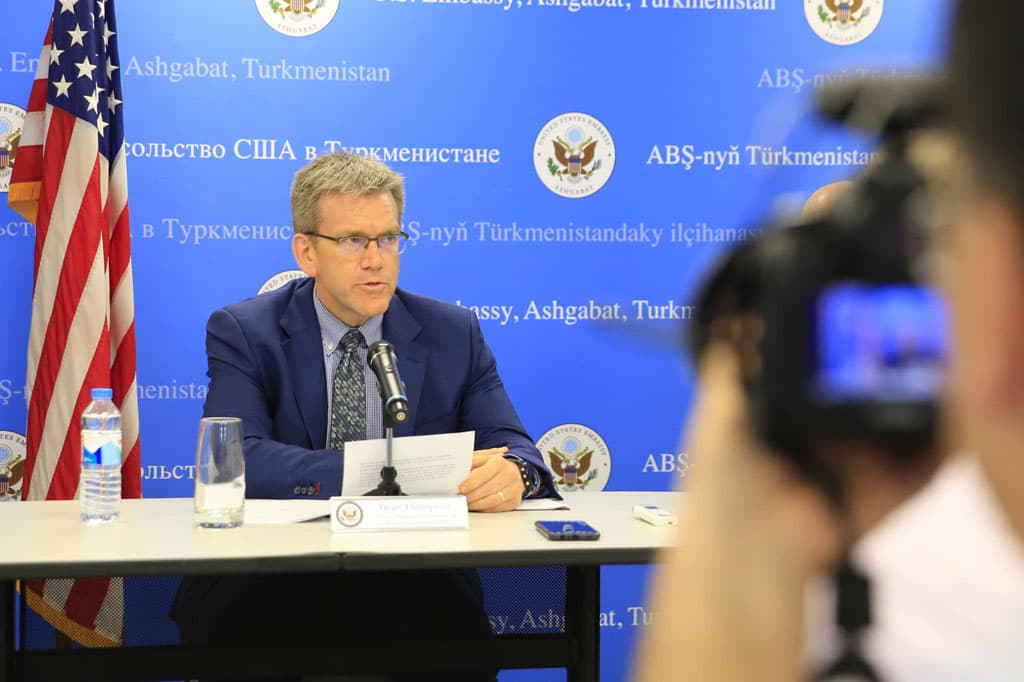
"We want to promote more transparency, interconnectedness in the region. This includes respect for the rights of citizens of Central Asian countries. This includes ensuring such conditions when, for example, journalists can freely do their work," Dean Thompson, First Deputy Assistant Secretary of State for South and Central Asian Affairs, said at a media briefing in Ashgabat on Monday.
A delegation of the US State Department headed by the Director General of the Diplomatic Service Carol Peres visited Ashgabat and on Sunday, held a meeting at the Ministry of Foreign Affairs of Turkmenistan with the head of the country's foreign ministry Rashid Meredov.
The meeting of Dean Thompson with representatives of the press, as well as the day before at the Foreign Ministry, was attended by U.S. Ambassador Matthew Stephen Klimow.

The question from ORIENT, a fragment of the answer to which is given above, sounded like this:
– The U.S. Strategy for Central Asia for 2019-2025 notes that the United States will support efforts to overcome the differences that divide the region. Tell me, Mr. Thomson, what differences are there in mind?
– In the context of its Strategy for Central Asia, the United States considers cooperation on a wide range – from economic to climatic. We want to promote more transparency, connectivity in the region. As for disagreements, we are not looking for them, but are thinking more about how to create an atmosphere in which they do not arise. This, of course, includes advancing the rights of citizens of Central and South Asian countries. This includes ensuring conditions where, for example, journalists are free to do their work.
Naturally, we understand that there are consequences of withdrawal (American – ed.) Troops from Afghanistan, and President Biden has made it very clear that we will do everything possible to prevent Afghanistan from being used as a platform for terrorist activities in the future. For this, it is very important to strengthen the borders of nearby, neighboring countries in the region," Thomson said.
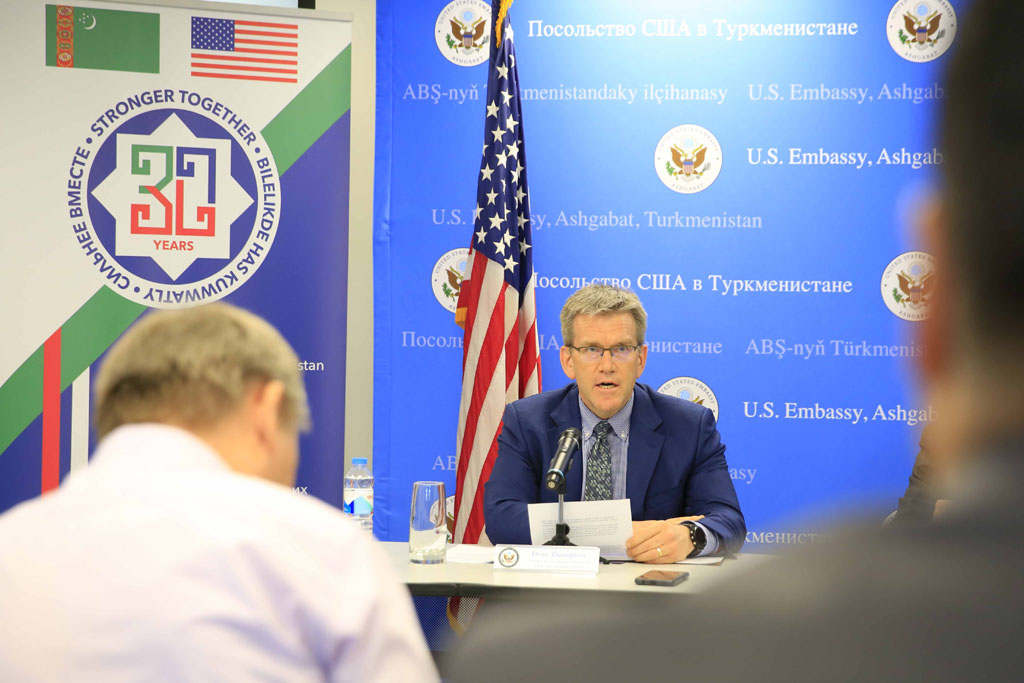
– We hope to build our joint work with partners in Central Asia on various important issues in this difficult, historical time. In this work, the United States aims to support the Central Asian countries in order to strengthen their independence, sovereignty and territorial integrity, realize their enormous economic and commercial potential so that the region can be a strong partner for the rest of the world in such areas as security, countering terrorism and violent extremism. That is, these are strategic areas that have an impact on all of us," the First Deputy Assistant Secretary of State for South and Central Asian Affairs said during a briefing.
...He added that after his visit to Ashgabat, he will also have meetings in Tashkent, in addition, US Assistant Secretary of State Donald Lu is coming to the region this week. "And our combined efforts are aimed at maintaining cooperation with Central Asian countries," Thomson said.
Answering another question from ORIENT concerning the water issues of the Central Asian region and possible assistance in this from the United States, the representative of the State Department said:
– Yes, of course, the issue of water is very important and complex not only for the Central Asian states, but also around the world, especially in our era of changing climatic conditions on the planet. Not being an expert in this field, I can say for sure that the United States is ready to provide assistance where it would be useful to resolve such issues.

– You probably know about the great efforts of former Secretary of State Kerry to protect the environment and climate change, and for the current US administration this remains a big priority, and we will continue to look for opportunities where we can promote a good response to climate challenges and ensuring citizens' access to clean drinking water, – Thomson assured.
There was also a question at the briefing related to the recent statement by the Taliban representative in Moscow that security threats to the construction of the TAPI gas pipeline in Afghanistan have been eliminated.
– At this important, historical moment, we support all efforts to diversify energy flows. We know that for Turkmenistan, the TAPI project is one of the important infrastructure projects that it seeks to implement. I think that I am not in the position to give any assessment of the risks or insist on a certain point of view of another country about what security factors they (the Taliban - ed.) are ready to provide for the implementation of such a project.
(PHOTO 5)
– All I can say is that traditionally the United States has supported the diversification of natural gas supply routes from Turkmenistan. I think that the four participating countries of the project should come together and decide what security factors need to be taken into account in order to implement this project," Thomson said.
Answering another question about which areas of Turkmen-American cooperation were identified at the meeting of the State Department delegation with Minister Rashid Meredov as the most promising, he stressed that there are many such areas.
– There are many areas that look very promising for the future. We discussed (in the Ministry of Foreign Affairs of Turkmenistan – ed.) the continuation of our close cooperation to strengthen border security so that Turkmenistan is able to protect its borders from external threats. They also considered further expansion of business opportunities between our two countries and, in general, improving and harmonizing the business climate of Turkmenistan so that the country would be more open to external investment, which in turn would help create additional jobs and open up other new opportunities.
We also discussed climate change issues, and we support and call on Turkmenistan to join the commitments to reduce methane emissions into the atmosphere, knowing that it is considering such an opportunity. And these are just some of the areas that we discussed and where we see great prospects. We are very pleased with the state of our cooperation and hope for its continuation in a constant dialogue with the government," concluded Thomson.

Before the Q&A session, the First Deputy Assistant Secretary of State for South and Central Asian Affairs also told reporters that during the visit he visited the historical and cultural reserve "Nisa", thanks to which he got a new idea about the legendary history of the Great Silk Road and the Turkmen people.
"I have met with graduates of exchange programs in the United States who have achieved great success in business, digitalization, law and women's empowerment – all this will contribute to the further growth of Turkmenistan," Dean Thomson expressed confidence.
"I just met a group of extremely talented Turkmen girls who are developing smartphone apps," he added.
Speaking about the "positive trajectory of bilateral relations over the past thirty years," he noted that the United States and Turkmenistan maintain strong ties in many important areas, such as security, climate change, business and commercial contacts, preservation of cultural heritage.

"And this is just the beginning. The U.S. Embassy is in constant dialogue with the Government of Turkmenistan on how to expand our cooperation in all these areas. We will continue to work with the Government of Turkmenistan to strengthen economic ties, stimulate economic growth and create jobs in both countries," Thomson said.
"In the famous Turkmen legend, Oguz Khan broke one arrow to demonstrate its weakness, and then collected a bunch of arrows to illustrate the indestructible power of unity. As the legend says, we are always stronger together," the diplomat turned to historical images.
And in conclusion he said:

"I am leaving Turkmenistan with gratitude for the time that was given to me so that I could better appreciate the rich cultural heritage of your people, feel the kindness and hospitality of Turkmens and admire the beauty of your landscapes. Many thanks to everyone I met here in Turkmenistan for telling me about your history and culture and giving me memories that will stay with me for the rest of my life."
Bekdurdy AMANSARYEV