What is “Incoterms 2020”: definitions and examples?

Incoterms 2020 refers to the latest set of international trade terms published by the International Chamber of Commerce (ICC) that define the responsibilities of buyers and sellers in international trade transactions. The terms are recognized globally and are used to clarify the tasks, costs, and risks associated with the transportation and delivery of goods.
There are 11 Incoterms 2020 rules, each with its own specific definition and implications for both parties involved in a transaction. In the previous article we gave a brief description of each rule, and in this article we would like to supplement the definitions with examples of key rules of Incoterms 2020::
-
EXW (Ex Works): The seller's responsibility is to make the goods available at their premises, and the buyer is responsible for all other tasks, such as loading the goods onto a truck and arranging for export clearance. An example of this can be found in a scenario where a manufacturer in China (seller) sells goods to a retailer in the United States (buyer) under the EXW Incoterm.
-
FCA (Free Carrier): The seller is responsible for delivering the goods to a carrier or another person nominated by the buyer at the seller's premises or another named place. An example of this could be a shipment of goods from a supplier in Germany (seller) to a distributor in France (buyer) under the FCA Incoterm.
-
CIP (Carriage and Insurance Paid To): The seller delivers the goods to a carrier or another person nominated by the seller at an agreed place, and also pays for carriage to the named place of destination. The seller also contracts for insurance cover against the buyer's risk of loss of or damage to the goods during the carriage. A real-life example could involve a shipment of electronics from Japan (seller) to a retailer in Australia (buyer) under the CIP Incoterm.
-
CPT (Carriage Paid To): The seller delivers the goods to a carrier or another person nominated by the seller at an agreed place, and also pays for carriage to the named place of destination. An example of this could be a shipment of agricultural products from Brazil (seller) to a warehouse in Canada (buyer) under the CPT Incoterm.
-
DAP (Delivered at Place): The seller is responsible for delivering the goods, ready for unloading, at the named place of destination. The seller bears all risks involved in bringing the goods to the named place. An example of DAP Incoterm would be a shipment of clothing from Vietnam (seller) to a retail store in the United Kingdom (buyer).
-
DPU (Delivered at Place Unloaded): The seller is responsible for delivering the goods, unloaded from the arriving means of transport, at the named place of destination. An example of this could be a shipment of machinery from Germany (seller) to a construction site in the United States (buyer) under the DPU Incoterm.
-
DDP (Delivered Duty Paid): The seller is responsible for delivering the goods to the named place in the country of the buyer, and pays all costs including import duties and taxes. An example of DDP Incoterm could be a shipment of luxury goods from France (seller) to a high-end boutique in Japan (buyer).
-
FAS (Free Alongside Ship): The seller delivers the goods to the named port alongside the vessel nominated by the buyer. An example of FAS Incoterm is a shipment of raw materials from Australia (seller) to be loaded onto a ship at a port in China (buyer).
-
FOB (Free on Board): The seller delivers the goods on board the vessel nominated by the buyer at the named port of shipment. An example of FOB Incoterm could involve a shipment of electronics from South Korea (seller) to a warehouse in the United States (buyer).
-
CFR (Cost and Freight): The seller delivers the goods on board the vessel or procures the goods already so delivered. An example of CFR Incoterm could be a shipment of agricultural products from Argentina (seller) to a port in Italy (buyer).
-
CIF (Cost, Insurance, and Freight): The seller delivers the goods on board the vessel or procures the goods already so delivered. An example of CIF Incoterm could involve a shipment of construction materials from Malaysia (seller) to a port in Australia (buyer).
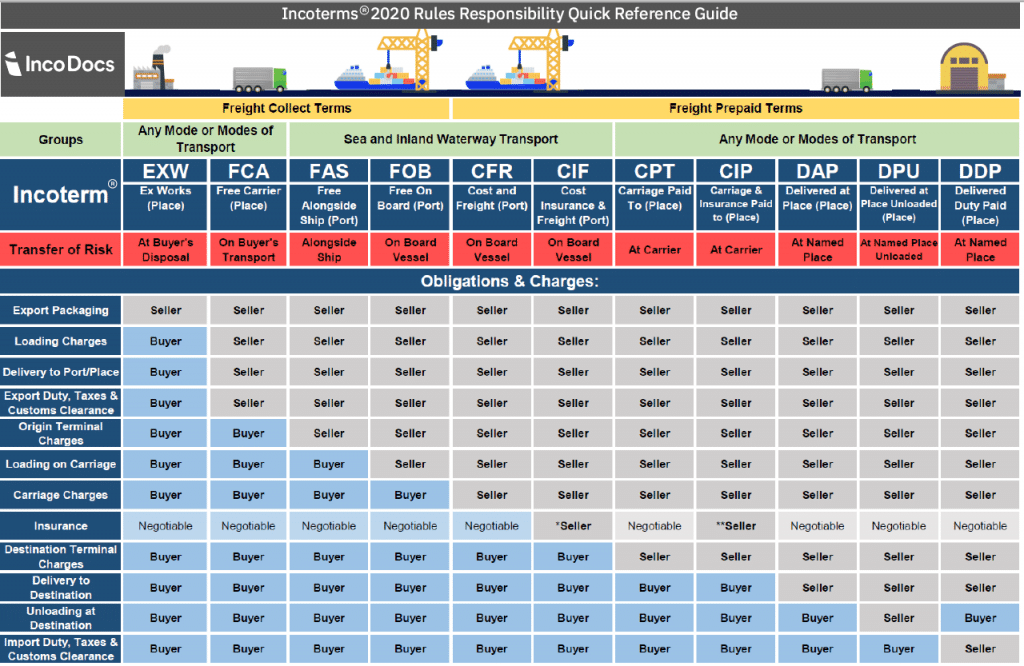
Remember to carefully consider the specific implications and responsibilities associated with each Incoterm when engaging in international trade transactions and consult the official ICC resources for complete guidance.
For a comprehensive understanding of all Incoterms 2020 rules, it is advisable to refer to the official ICC website (https://iccwbo.org/resources-for-business/incoterms-rules/incoterms-2020/) or the official publication of the International Chamber of Commerce titled "Incoterms 2020."
Remember that when using Incoterms, it's essential to communicate clearly and precisely with your trading partners and seek legal advice if needed to ensure that the chosen terms are suitable for your specific trade transaction.


