||





We're used to measuring a child's success by grades and achievements in school. But does this always reflect their true potential? Sometimes labels like "underachieving" or "not capable enough" hide a unique way of thinking that simply doesn't fit into standard frameworks.
Did you know that Walt Disney was considered insufficiently creative early in his career, or that Albert Einstein was considered a slow learner by his teachers as a child?
The stories may be embellished, but the point is this: school grades don't always reflect a person's true potential.
School is just one of the "stadiums" where talent is revealed. If your child isn't first in the 100-meter dash, they may be the best swimmer; you just haven't gotten to the pool yet.
The world has made enormous strides. We're flying into space, creating neural networks, and changing our understanding of human capabilities. But our assessment systems for children are still largely built on the models of the past.
We often measure success by problem-solving and word processing skills. And we jump to conclusions if a child fails to demonstrate excellence in these areas. Sometimes, in this system, a child is labeled "weak" or "underachieving." Yet, at the same time, they may have a keen sense of people, come up with innovative solutions, or create complex things with their own hands.
This is precisely why a different view of intelligence has emerged in pedagogy.
In 1983, American psychologist Howard Gardner proposed viewing intelligence not as a single universal ability (IQ), but as a combination of various cognitive systems. This model is not rigorously scientifically proven, but it significantly expands our understanding of how human abilities can manifest themselves differently.
Gardner's Types of Intelligence:
• Linguistic – a love of words, stories, and languages.
• Logical-Mathematical – working with numbers, structures, and patterns.
• Spatial – developed visual thinking and imagination.
• Bodily-Kinesthetic – thinking through movement and action.
• Musical – sensitivity to rhythm, tone, and sound.
• Interpersonal (Social) – the ability to understand and empathize with others.
• Intrapersonal – a tendency toward introspection and deep thinking.
• Naturalistic – sensitivity to nature and the systems of the living world.
• Existential – reflection on meaning, life, and big questions.
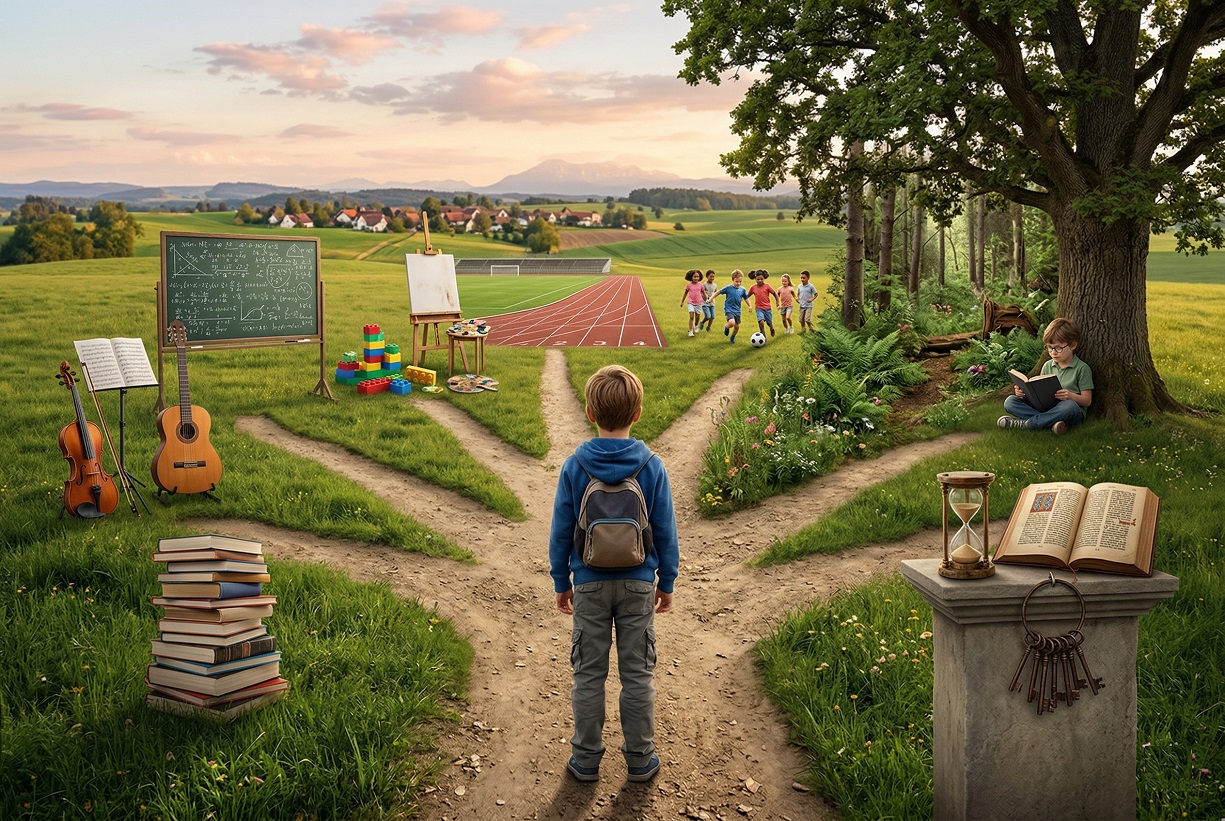
"I Can't Do It!" Isn't a Death Sentence.
If a child with a pronounced kinesthetic intelligence is taught physics only through text and formulas, they may not understand the material.
Not because they're "incapable," but because the method of presentation doesn't match their learning style. It's important for them to see, to try, to experience it.
How to Change the Situation
Observe. When do your child's eyes light up? What sparks genuine interest?
Pay attention to spontaneous activity. What does he do enthusiastically and without prompting? Does he draw, build construction sets, organize games, or observe nature?
Support his unique strengths. If he has difficulty counting, but is excellent at building, inventing, or organizing, then this is already a manifestation of thinking.
Eliminate comparison. The only valid reference point is his former self.
A parent's job is not to force a child to fit a system, but to help them discover their strengths. To do this, it's important to select specific learning methods based on the child's intelligence type.
For example, a naturalistic type might benefit from nature walks, caring for plants or a pet, while a musical type might benefit from playing with sounds and rhythms, learning to play instruments, and learning to play them.
A kinesthetic type might benefit from activities such as child-centered experiments, modeling, and sports, while an interpersonal type might benefit from team games, volunteering, developing leadership skills and the ability to lead others, etc.
When a child feels accepted and their abilities are recognized, they gain the inner resources to improve in areas that are more challenging.
What Should You Say to Your Child Today?
Instead of "Why are you so inattentive?" try:
"It seems like this method isn't working for you. Let's try a different way, like drawing or building this?"
"Grades aren't the whole picture. I see how well you're doing..." (indicate your child's strength).
"We're just looking for your way to understand this. And we'll definitely find it."
...The stories of famous people are often inspiring precisely because their paths weren't straightforward. Many of them didn't fit into the standard system, but that didn't stop them from discovering their strengths.
It's important to understand that the theory of multiple intelligences isn't the only approach. Other models exist, and the scientific community continues to debate how best to measure and develop human abilities. But that's another topic.
The challenge today is to convey an important message to parents: "A child may not fit the system and still have high potential. Perhaps your child isn't lagging behind. Perhaps they're simply on their own path. And your job isn't to speed them up, but to lead them astray."
Observe your child today: what lights up their eyes? Perhaps that's where the key to their future success lies.
Shamamed Annaev