||




 Chinese New Year
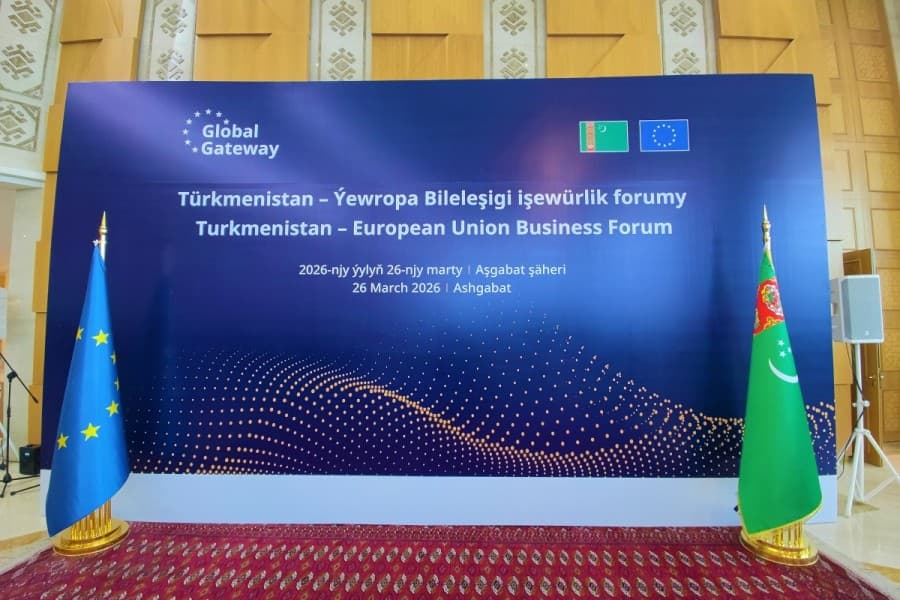
ORIENT | March 26. The Turkmenistan-European Union Business Forum in Ashgabat has become a rallying point for a new model of interregional cooperation. When the country's top economic leadership, heads of diplomatic missions, and senior management of European development institutions gather in one room, the discussion is no longer simply about intentions, but about a concrete roadmap for integration.
The forum was opened by Turkmenistan's Minister of Finance and Economy, Mammetguly Astanagulov. His speech set the tone for the entire meeting: Turkmenistan is entering a phase of deep structural modernization. The minister emphasized that today's priority is not simply attracting capital, but creating an ecosystem in which European technologies and management standards will become a catalyst for national business.
This sentiment was echoed by EU Ambassador to Turkmenistan Beata Peksa. She noted that the "New Horizons" in the forum's title are, first and foremost, horizons of predictability. The European Union is ready to invest in Turkmenistan's soft and hard infrastructure, seeing the country not only as a resource hub but also as a reliable link in the global supply chain.
The Effect of Openness
The most resonant part of the forum, judging by the exchange of opinions behind the scenes, was the presentation by representative of the Ministry of Foreign Affairs, Atageldy Khaldzhanov, Head of the Department of International Economic Cooperation. Instead of the usual protocol clichés, forum participants heard a detailed analysis of reality. The position of the Ministry of Foreign Affairs was stated with absolute clarity: in the context of global transformation, no country can afford to prosper in isolation. Old market paradigms are changing, and today, those who know how to play in a team survive.
Three Pillars of the New Strategy
Transport Connectivity: The Trans-Caspian Route is recognized as a "cornerstone." The Ministry of Foreign Affairs is confident that synchronization with the EU Global Gateway initiative will transform the corridor into a digital highway where bureaucracy is minimized.
Investment Climate: A direct appeal was made to European companies—they are seen not simply as investors, but as "transformative partners." The process of joining the WTO was described as a principle for Turkmenistan's economic modernization and its integration into the global market.
Green Matrix: Turkmenistan has reaffirmed its commitment to reducing methane emissions. This is not a passing fad, but rather a commitment to long-term technological compatibility with the EU economy.
Session Analysis: From SMEs to Green Finance
Key market players and national experts spoke during panel discussions moderated by International Trade Center (ITC) experts Elena Butrimova and Mondaire Mimouni.
Olivier Cuny (EIB) and Grigory Savva (EBRD) confirmed their readiness for "blended financing" of projects. This is critically important for the Turkmen private sector, represented, in particular, by Ykhlas Khudainazarov, CEO of Miwe OJSC.
Deputy Minister of Economy Babaniyaz Yalakov and Customs Service representative Ata Rakhmanov discussed in detail the digitalization of procedures. Without a "smart" customs service, no transport corridor will ensure the required speed.
Ambassadors from Germany (Bernd Heinze) and other EU countries, as well as representatives from the OECD (Céleste Laporte Talamont) and GIZ (Joachim Fritz), presented their vision of Turkmenistan as a "preferred partner."
Dozens of meetings took place on the sidelines of the forum, covering sectors from logistics to energy, from agriculture to digital solutions. These weren't just talks; they were the foundation for future contracts, partnerships, and investments.
"We Are Listening to You."
Atageldy Khaldzhanov's closing remarks were the quintessential message of the day. He said that Turkmenistan is carefully studying feedback from businesses—both on what's working and on existing barriers.
From the forum's podium came a clear assurance: "We are listening to you." The Ministry of Foreign Affairs is acting as a "bridge" not only between East and West, but also between the ideas of companies and the actions of government. The signing of the agreement to extend the GIZ climate project was tangible proof that the forum ended with more than just words, but with concrete commitments.
The Ashgabat forum demonstrated that the uncertainty of the global order strengthens partnerships among those prepared for open and honest dialogue. "Every voice was heard, and every idea was understood," was the closing remark.