||




 Chinese New Year
ORIENTIR | March 25. The world crossed the midpoint of the week of March 25, 2026, in a state that experts describe as a resonance of global crises – a rare and dangerous confluence of vectors, when political instability and market volatility have combined with the physical paralysis of key sea routes. While the straits remain zones of extreme risk, the center of gravity of global stability is inexorably shifting to land.
The speed with which the energy storm is unfolding is astonishing! While Brent crude oil was holding at $114.20 on Monday, by Thursday morning it had consolidated at $116.80.
Gas added another $30 to its already sky-high price of $1,420 in the same 72 hours, while gold, reflecting a global tectonic shift, confidently surpassed $2,212 per troy ounce.
The current demand for metal is not simply a search for a safe haven, but a conscious choice by investors to favor tangible assets. In a climate where maritime logistics are becoming unpredictable, precious metal remains a universal measure of stability, unaffected by stock market prices or port terminal operations.
Current demand for metal is not simply a search for a safe haven, but a conscious choice by investors in favor of tangible assets. In a climate where maritime logistics is becoming unpredictable, precious metal remains a universal measure of sustainability, unaffected by stock market prices or port terminal operations.
According to German Vice-Chancellor Robert Habeck, "Europe's industrial heart could simply grind to a halt" due to resource shortages. In a climate where maritime logistics is becoming an area of uncertainty, metal and pipeline resources remain reliable indicators of sustainability.
At the intersection of critical interests, old supply rules cease to apply. As Donald Trump emotionally remarked in a recent speech, "The world is witnessing the greatest humiliation as sea lanes become toll rides." This assessment, however harsh, reflects the depth of that tectonic shift, as the center of global stability inexorably shifts from the vast oceans to the solid ground of the Eurasian continent.
The scale of the challenges is clearly evident in the examples of major economies. For example, the Chinese government imposes emergency price controls on fuel. This entirely justifiable decision was dictated primarily by concern for Chinese citizens and the desire to minimize the burden on the population in the face of an abnormal spike in global prices. Without these support measures, consumer costs would have increased exponentially.
Beijing understands that supply security should not be held hostage to geographic bottlenecks. As Xi Jinping emphasized, the land connectivity of Eurasia today guarantees the survival of civilization. Against this backdrop, our region maintains natural stability and a gasoline price of 60-65 cents per liter, demonstrating the effectiveness of self-sufficiency policies.
The situation is exacerbated by the fact that maritime logistics has effectively become hostage to non-market burdens and the commercial burden of extremely high risks. Tanker insurance has increased tenfold, and today a single voyage through the dangerous waters of the Persian Gulf can cost up to $2 million in so-called "insurance premiums" alone.
This effectively paralyzes traditional trade relations. Iranian Foreign Minister Abbas Araghchi, in a dialogue with his Chinese counterpart Wang Yi, emphasized that shipping security today directly depends on the status of the parties to a conflict. Which parties? Clearly, no comment. Maritime logistics has lost its main feature – universal accessibility.
Experts believe that, amid the Middle East crisis, those countries that possess oil and gas resources, even if not indirectly involved in the conflict, are benefiting. In this context, visits by delegations from India and the European Union to Ashgabat and Tashkent take on special significance.
Amid increasing geopolitical fragmentation and escalating international tensions, Turkmenistan's neutrality is becoming an important tool for ensuring global stability. President Serdar Berdimuhamedov emphasizes that "the country is using its neutral status to advance the peacekeeping agenda and ensure global security."
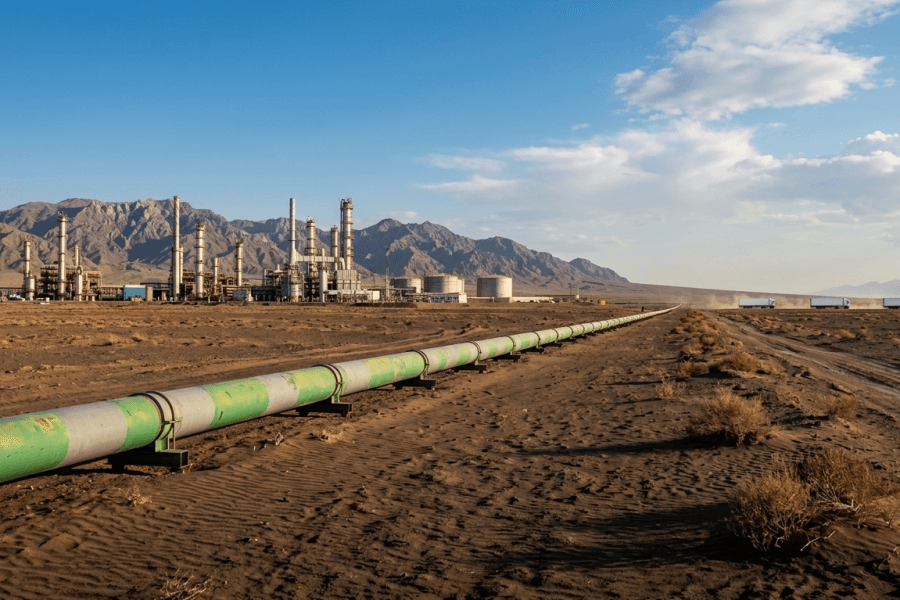
With sea routes blocked, Central Asia's land routes could become the Great Gas Route of modern times, continuing the functions of its ancient namesake. After all, our Central Asian region, essentially neutral, is a reliable haven for cooperation and joint efforts for peace with all those who are truly interested.
Bekdurdy AMANSARYEV