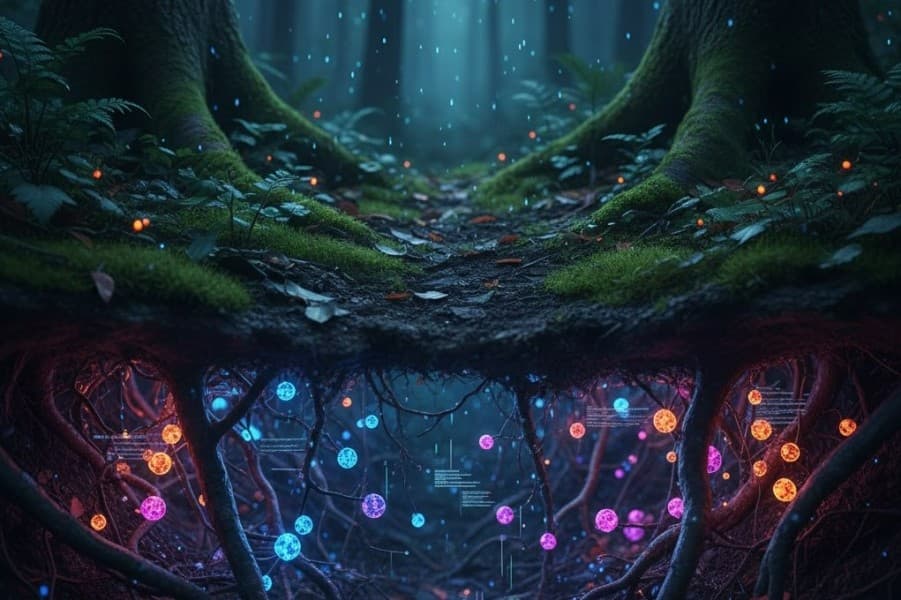



In January 2026, the prestigious Tyler Prize, internationally known as the "Nobel Prize for Ecology," was awarded to American biologist Toby Keirs. She became the youngest woman in history to receive this award. Her achievement is the discovery that beneath our feet exists a complex "market economy," created by fungi and plants millions of years ago.
Evolutionary biology professor Toby Keirs has dedicated her life to studying mycorrhiza—the symbiosis between fungi and plant roots. It was long believed that fungi in the soil were merely passive "pipes" for transmitting water. Keirs proved otherwise: they are active players, strategists, and even "traders."
Underground Exchange: How Fungi Bargain with Trees
It turns out that mycorrhizal fungi are the main "storers" of carbon. Every year, plants transfer about 13 billion tons of CO₂ to fungal networks—roughly a third of all global fossil fuel emissions.
Fungi literally "lock" carbon in the soil, turning it into a giant battery of life. Without healthy fungal networks, the fight against global warming is impossible.
Using high-tech tools (robotic imaging and glowing quantum dots), Kirs's team has seen something incredible: fungal networks behave like skilled economists.
Exchange Strategy: Fungi transfer scarce phosphorus from where it's abundant to where plants are in dire need.
Resource "Price": In exchange, fungi demand carbon from plants. If a tree is "greedy," the fungal network can limit the supply of minerals. This calculating barter maintains the balance of life on the entire planet.
"We're used to looking at life on the surface, but the real power lies beneath. A single gram of soil is equivalent to an entire galaxy," Toby Kearse says.
A Weapon Against Drought: How Will This Help Water-Stressed Regions?
For regions like Central Asia, Toby Keirs's discoveries are critical. In arid and desert ecosystems, fungal networks act as an "intelligent irrigation system":
— Moisture retention: Fungal mycelium is many times finer than the smallest root. It penetrates soil micropores inaccessible to plants and "squeezes" out the remaining moisture.
— Enhanced survival: Inoculating roots with the right fungi allows seedlings to survive extreme heat and salinity.
— Soil restoration: Instead of simply planting trees in sand, Keirs's strategy involves first "populating" the soil with partner fungi. This creates a living foundation, without which a desert forest is doomed to die.
Together with her organization SPUN (Society for the Protection of Underground Networks), Toby Kearse has launched the world's first "Underground Fungal Biodiversity Map." Scientists from 80 countries are already sending soil samples to map hidden hotspots.
Incidentally, the Underground Advocates program, launched by Kearse, trains scientists in legal tools for protecting these "invisible" ecosystems at the national level.
Is the Future of AI in Plant Roots?
Toby Keirse's research has attracted the attention of tech giants, including Google DeepMind. AI developers are intrigued by the unique ability of fungal networks to make decentralized decisions. Scientists believe that mimicking the natural trading systems and resource allocation algorithms created by fungi millions of years ago will help create more efficient and sustainable IT infrastructures of the future.
The Tyler Prize for Environmental Achievement was established in 1973. It is worth US$250,000. Toby Keirse is the first person to receive this award specifically for her research on the microcosm of soil as a global climate regulator. Previously, the prize was more often awarded for ocean protection or the fight against ozone depletion. With her triumph, Keirse has officially elevated the "underground world" to the top of global policy priorities.
The award ceremony and Toby Keirse's official address to the global community are scheduled for April 23, 2026, in Amsterdam.