We are guided by what unites people




News
Articles
Media
Announcement
 Chinese New Year
Technology
About Us
Contacts
Chinese New Year 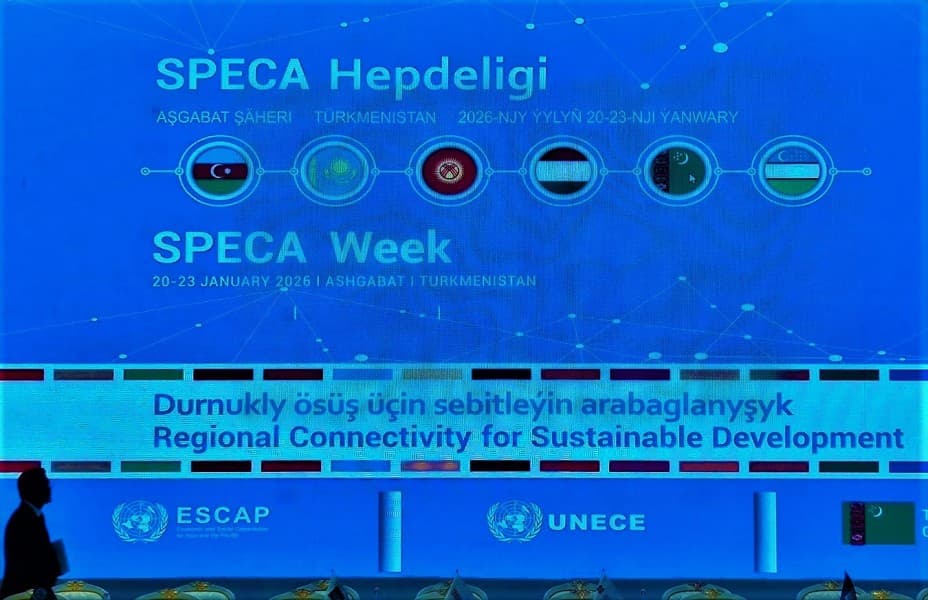
Ashgabat, January 21 | ORIENT. Today, the conference halls of the Yildiz Hotel became the epicenter of big geopolitics and pragmatic economics. The Economic Forum, part of SPECA Week, opened in Ashgabat. The theme, "Regional Connectivity for Sustainable Development," sounds academic, but behind it lies billions in investment and the future of transport arteries from China to Europe.
Architecture of Trust: High-Level Segment
Opening the forum, Turkmenistan's Minister of Finance and Economy, Mammetguly Astanagulov, set the tone for the entire discussion: peace and trust are not abstract concepts, but fundamental capital for business.

The uniqueness of the moment was underscored by the presence of international diplomacy heavyweights. The discussion was joined virtually and in person by the heads of the UNECE and ESCAP, ministers from the G7 SPECA countries (from Azerbaijan to Uzbekistan), as well as special representatives from the EU, the World Bank, and the China-Central Asia format.
Analytical Snapshot: This constellation of participants confirms that Ashgabat has successfully transformed SPECA from a local program into a powerful interregional platform. Participants were particularly drawn to the presentations by Eduards Stiprais, the European Union Special Representative for Central Asia. His participation in the discussion confirms Brussels' strong interest in developing the Trans-Caspian route. According to experts, synergy between EU initiatives (such as the Global Gateway) and SPECA's legal instruments could create seamless logistics that will connect European ports with the industrial centers of our region.

Caspian Energy: From Resource Base to Network Synergy
The first panel of the forum was devoted to energy interconnectivity, a topic in which Turkmenistan is a recognized global champion. The key message of the session was that the region must move away from isolated systems toward a "nexus" model—the inextricable link between water, energy, and the environment.
Modeling 2026: UNECE presented research findings suggesting that deep integration of Central Asia's power grids will optimize resource use. This is not simply a matter of saving money, but a strategy for survival in the face of climate change.
Sustainability and Decarbonization: Instead of focusing on raw materials, SPECA countries are emphasizing the development of low-carbon energy infrastructure. Participants discussed how a unified grid will help balance renewable energy capacity, making energy supplies reliable and affordable.
Regional Planning: As Deputy Minister of Energy of Turkmenistan Nurmammet Nurmammedov noted, coordination in the energy sector reduces infrastructure costs and directly impacts the health of the region's ecosystems, particularly in the Caspian Basin.

Turkmenistan, based on its three UN General Assembly resolutions, is offering its SPECA neighbors an "energy shield." The idea is that the integration of grids and gas transportation routes creates insurance against resource shortages and makes the region attractive to large-scale international investment.
From "Land Enclaves" to Global Bridges
The transport bloc has become the most contentious, as it is here that the physical survival of the region's economies in global trade is decided. The main challenge for SPECA countries is the lack of direct access to the oceans. According to data presented at the forum, the business community in landlocked countries pays twice as much for exports as coastal countries.
Strategy for Overcoming Barriers
Digital Transformation of Logistics: Deputy Minister of Railway Transport of Turkmenistan Silapberdy Nurberdyev and international experts emphasized the need to implement the e-TIR and e-CMR systems. This is not simply a paperless approach, but rather data synchronization, allowing cargo to cross borders without hours of delay.
Railway Breakthrough (SPECA-ASEAN): One of the session's ambitious objectives was to discuss the operationalization of routes connecting Central Asia with Southeast Asia (ASEAN). This opens a direct route to Pacific ports.
Integration of "dry ports": Participants discussed the creation of multimodal logistics hubs. Integrating such "dry ports" into a single transport chain transforms the region from a transit corridor into a full-fledged distribution hub for Eurasia.

Relying on six UN General Assembly resolutions on sustainable transport, initiated by Turkmenistan, gives Ashgabat the right to create formats and mechanisms for their implementation. The key message of the session was: transport connectivity is not only about rails and roads; it is, above all, about common legal instruments and UN standards (UN/CEFACT), which make borders transparent for legitimate businesses.
"We are turning a geographical challenge into a transit advantage," was the leitmotif of the session.
Strategic Continuity and Sustainable Trade
The final discussion of the first day focused on how to transform one-time logistics successes into a systemic economic model. The focus here was not on the distant future, but on the implementation of already adopted documents that shape the region today.

Building on the Ashgabat Initiative: Session moderator Shombi Sharp (ESCAP) and the speakers recalled the importance of the decisions taken in Ashgabat in 2019. It was then that the course toward reducing trade barriers through UN standards was set. Today's task is to translate these agreements into concrete pilot projects.
Circular Economy and Innovation: Deputy Minister of Finance and Economy of Turkmenistan Perhat Yagshiyev presented progress in implementing sustainable trade principles. This represents a significant shift from simple buying and selling to a closed-loop (circular) economy, where innovation helps reduce environmental impacts. This is vital for the region, where economic growth must go hand in hand with the protection of natural resources, including the Caspian Sea ecosystem.
Integration into Global Rules: The main goal of the session was to confirm the readiness of SPECA countries to work within the international trading system based on WTO rules and UN standards.

The first day of the forum concluded on a high note of preparation for the most technologically advanced stage. Tomorrow, January 22, delegates will begin discussing the Roadmap for the Digitalization of the Trans-Caspian Corridor. This is a practical step toward implementing UN/CEFACT standards, which will create a seamless digital bridge between East and West.
Over its 25 years of existence, the SPECA program has evolved from a consultative platform into an effective mechanism for regional integration. The Ashgabat Forum confirmed that the countries of the region no longer wish to be "hostages to geography"; they intend to become architects of a new Eurasian economy and actively utilize UN instruments to reduce trade costs and enhance the region's competitiveness in the context of global transformations.
The holding of SPECA Week in Ashgabat under Turkmenistan's chairmanship recognizes the country's role as an integration hub for the region. At a time when the global economy is suffering from unpredictable volatility and the disruption of traditional supply chains, Ashgabat offers regional diversification as the only reliable guarantee of stability. This is not simply a matter of finding new markets, but of creating a self-sufficient economic space within SPECA.

The integration of transport systems, the unification of energy capacities, and the transition to unified UN digital standards are the very "protective filters" that will help Central Asia minimize external shocks. Turkmenistan's chairmanship of the Program clearly demonstrates that our region is no longer an object of global processes, but is becoming an active player capable of offering the world its own model of sustainability—through dialogue, trust, and deep infrastructure interconnectivity.
SPECA 2026 in the Turkmen capital is a testament to the region's readiness for global competition. And judging by the first day, Central Asia is ready to play for high stakes.