||
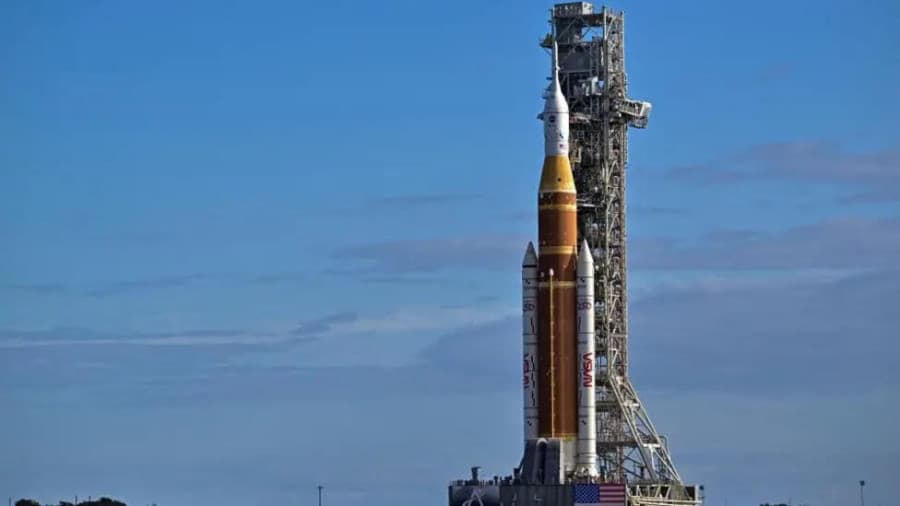
NASA’s super-heavy Space Launch System (SLS) rocket has been delivered to Launch Complex 39B at the Kennedy Space Center on Cape Canaveral, Florida. This milestone marks a key stage in the final preparations for the Artemis II mission — the first crewed flight to the Moon since the Apollo program.
The transfer of the 98-meter-tall rocket from the Vehicle Assembly Building to the launch pad took nearly 12 hours. Over a distance of 6.5 kilometers, the SLS was transported in a vertical position using a specialized crawler-transporter moving at a speed of no more than 1.3 km/h. The process was broadcast live.
Following the installation of the rocket on the launch pad, NASA specialists will begin a series of final inspections, tests, and the so-called “wet dress rehearsal,” which includes fueling the rocket and rehearsing all countdown procedures. According to the agency, the earliest possible launch date for Artemis II is February 6, with additional launch windows planned in February, March, and April.
The mission crew — NASA astronauts Reid Wiseman, Victor Glover, Christina Koch, and Canadian astronaut Jeremy Hansen — were present at the spaceport during the rocket’s rollout. In just a few weeks, they will take their seats aboard the Orion spacecraft, which will carry them into deep space.
The Artemis II mission does not include a lunar landing. Instead, the crewed spacecraft will fly around the Moon, including its far side, laying the groundwork for a future landing mission under Artemis III, which is scheduled for no earlier than 2027. Experts believe that 2028 remains the most realistic timeframe.
During the first days of the flight, the crew will remain in Earth orbit, traveling as far as 40,000 miles from the planet. The spacecraft will then head toward the Moon, reaching a distance of approximately 400,000 kilometers. While flying past the Moon’s far side, astronauts will spend several hours conducting observations, photography, and geological studies, helping to prepare for a future expedition to the Moon’s south pole.
A key role in the mission is played by the European Service Module, developed by the European Space Agency and built by Airbus in Germany. It provides the Orion spacecraft with power, propulsion, and essential life-support resources, including air and water for the crew.
Despite years of delays in the Artemis program, NASA emphasizes that safety remains its top priority. Mission leadership states that the launch will only proceed once all systems are fully ready, with no compromises regarding crew protection.
Artemis II will mark a historic step in humanity’s return to crewed lunar missions and open a new chapter in the exploration of deep space.
ORIENT




 Chinese New Year