||




 Chinese New Year
Elevations, landscapes and climates change dramatically as you move around the globe, but one factor remains nearly universal. All the diversity of the Earth is hidden under the blue sky. But why is the sky blue? This is not a reflection of the Earth's oceans. The real explanation requires a bit of particle physics.
We see blue above us because of the way the light from the Sun interacts with the Earth's atmosphere. The visible light spectrum contains many colors, from red to violet. When all the colors are mixed, the light appears white, Marc Chenard, a meteorologist of the US National Weather Service, told Live Sciencez. https://www.livescience.com/planet-earth/why-is-the-sky-blue
But once white light coming from the sun reaches Earth, some of the colors begin to interact with molecules and small particles in the atmosphere, he said.
Each color in the visible light spectrum has a different wavelength. For example, red and orange light have longer wavelengths, while blue and violet light have much shorter wavelengths. According to Chenard, it is the shorter wavelengths of light that are more likely to be scattered (or absorbed and re-emitted in another direction) by air and gas molecules in the Earth's atmosphere. Molecules in the atmosphere, mainly nitrogen and oxygen, scatter blue and violet light in all directions through a phenomenon called Rayleigh scattering. That's what makes the sky blue.
Simply put, when light passes through the atmosphere, most of the spectrum is sent further without stopping, but the blue and violet colors “cling” to the molecules and are reflected from them in different directions, giving the sky its characteristic color.
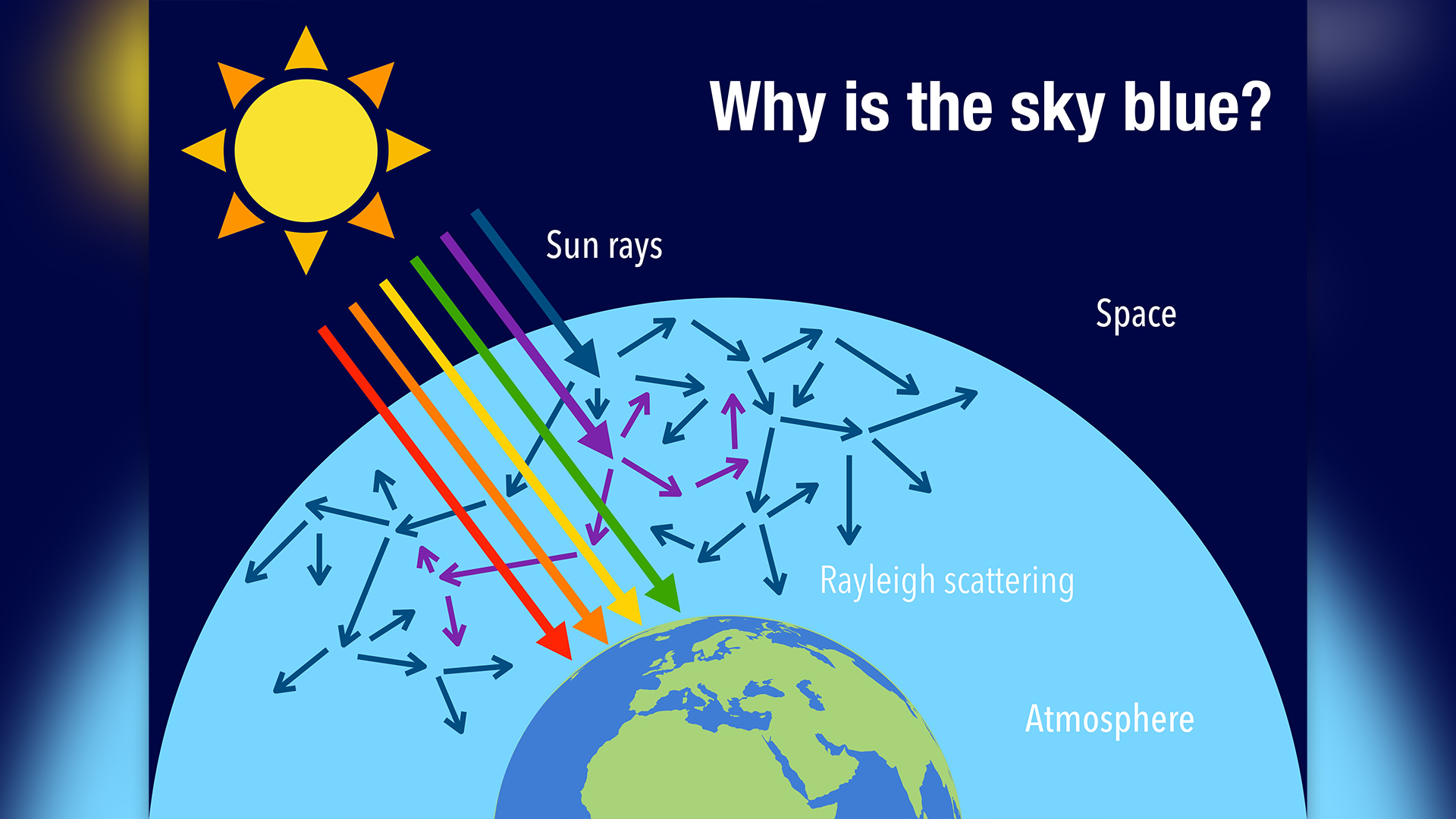
Here someone attentive will ask why the sky is blue and not purple. Here scientists also have an answer. As Ed Bloomer, an astronomer at the Royal Observatory of Greenwich in the UK, explained, sunlight initially contains more blue than violet. This is why more blue is scattered in the atmosphere “in absolute numbers” than violet.
In addition, the human eye does not perceive different colors equally. It is the violet color that our eyes perceive worse than blue.
As for “red” sunrises and sunsets, the principle is the same. When the sun is low on the horizon, the rays have to travel a greater distance in the atmosphere to reach our eyes. And by the time the light does get to you, all the blue light will simply scatter and get “lost” along the way. As a result, orange, red and yellow waves are all that are left to color the sunset.
Blue skies are the result of a combination of factors, Bloomer said. If you were on another planet, you might see a completely different color, depending on the molecules in the alien world's atmosphere, dust particles swirling around, or the spectrum of light coming from a nearby star.
ORIENT news