The chemical industry of Turkmenistan is a promising platform for foreign investors and mutually beneficial partnerships

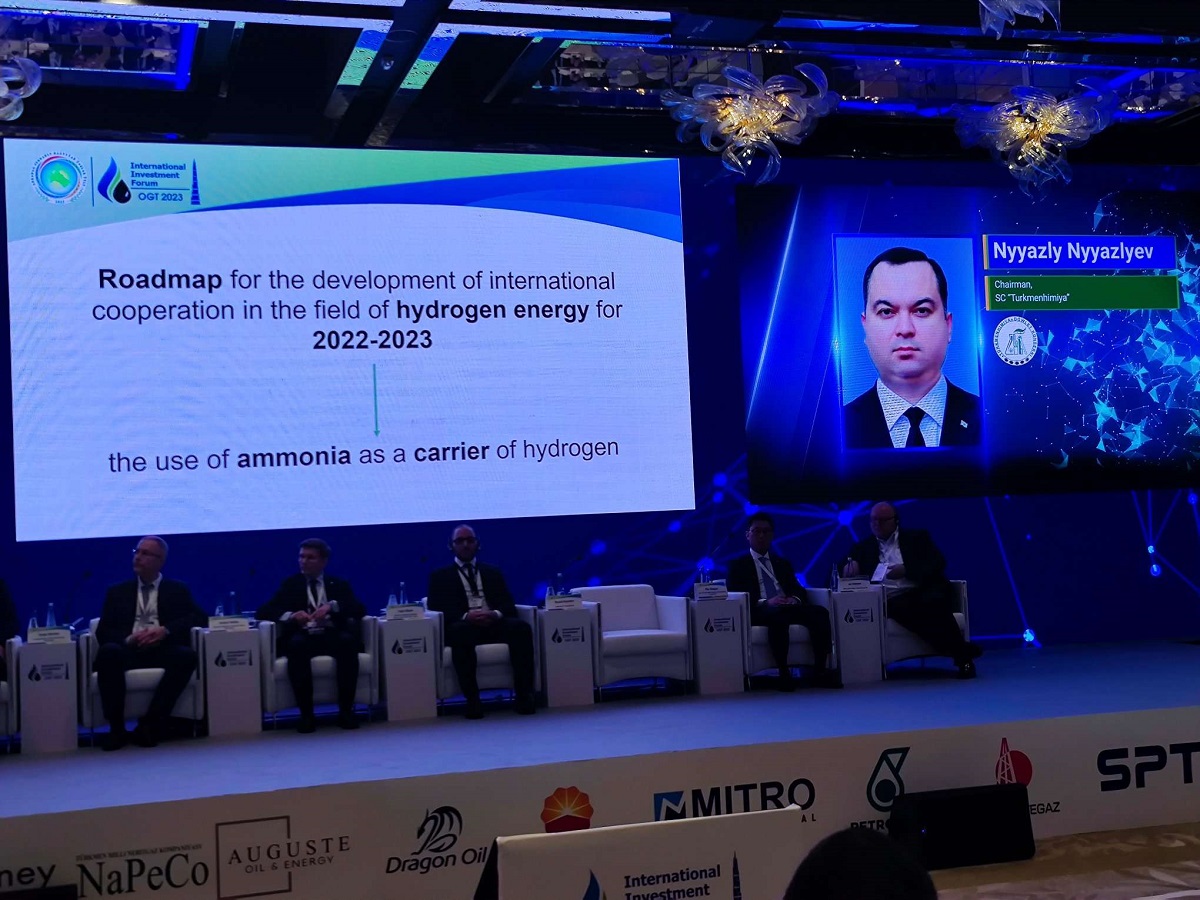
Today, the chemical industry of Turkmenistan is one of the most promising and developing sectors of the country's economy. In recent years, the largest chemical facilities have been put into operation - a plant for the production of ammonia and urea in Garabogaz, a polymer production plant in Kiyanli, a plant for the production of gasoline from natural gas in Ovadandepe. Moreover, the Turkmen chemical industry is focused on the maximum use of domestic hydrocarbon raw materials, said Niyazly Niyazlyyev, Chairman of the Turkmenhimiya Group of Companies, in his speech on Thursday at the investment forum in Dubai (UAE).
The large-scale program for the development of the chemical industry of Turkmenistan provides for the construction of new facilities for deep processing of natural gas using the most modern technologies that allow producing a variety of high-quality products that are widely in demand both on domestic and foreign markets.
In addition, in the near future, the Turkmenhimiya concern plans to start implementing a number of promising investment projects for the construction of new chemical enterprises. We are talking about a plant for the production of ammonia with a capacity of 660 thousand tons per year and carbamide with a capacity of 1,155 thousand tons per year, which will be built in the Balkan region. The next step is a workshop for the production of phosphorus fertilizer with a capacity of 300 thousand tons per year at the Turkmenabat chemical plant in the Lebap region, as well as the design and construction of a plant for the production of gasoline from natural gas with a capacity of 600 thousand tons per year in the Ahal region, Niyazlyyev told the participants of the Dubai forum.
In addition, Turkmenistan pays great attention to low-carbon technological processes with a minimum level of carbon dioxide emissions into the atmosphere. In particular, we are talking about the production of so–called blue ammonia - the technology provides for almost complete capture of carbon dioxide released in the production process.

Another promising direction for the development of the chemical industry is the production of hydrogen. The topic is very relevant today – many countries are gradually abandoning fossil fuels, and environmentally friendly energy sources should replace them. Hydrogen is becoming such an alternative, the chairman of "Turkmenhimiya" continued.
Turkmenistan has already started developing a national strategy for the development of hydrogen energy – a Roadmap for the development of international cooperation in the field of hydrogen energy for 2022-2023 has been created. The technological processes of hydrogen production are not the most complicated, such as, for example, the issue of its transportation and storage. Moreover, one of the solutions to this problem is the use of ammonia as a hydrogen carrier.
This direction has recently attracted more and more attention, since ammonia can be used as a promising material for the accumulation, storage and transportation of hydrogen energy to consumers. Ammonia can be easily liquefied and transported, and if necessary converted into hydrogen fuel, Niyazly Niyazlyyev explained.

Turkmenistan is famous not only for its large reserves of natural gas, but also for its huge deposits of solid minerals, including potash ores. Such deposits with potash salt manifestations as Garlyk, Karabil and Tyubegatan are of the greatest interest for development. All these "storerooms" are located in the South-East of Turkmenistan in the Lebap region.
Their total reserves, according to preliminary data, amount to more than 2 billion tons of potash ores.
The State Concern "Turkmenhimiya" is currently developing the Garlyk deposit, and in the near future plans to start developing the Karabil potash salt deposit.

Turkmenistan also occupies one of the leading places in the world in terms of reserves of hydromineral raw materials, which include intercrystal and surface brines of the Garabogazgol Bay and underground iodine-bromine waters. Garabogazgol Bay is considered to be the largest deposit of sodium sulfate and other minerals on the globe, which are an almost inexhaustible source of raw materials for the production of a number of magnesium, sodium salts, bromine, boron and lithium compounds.
In the near future, a major project is planned to be implemented in the chemical industry of Turkmenistan - the construction of 3 separately located new plants for the production of iodine, bromine and their derivatives with a total production capacity:
― iodine production - 750 tons per year
― bromine production – 9,850 tons per year
― production of iodine and bromine derivatives – will be determined by projects, in accordance with marketing research of world markets.
The implementation of these projects is planned by attracting large investments to the chemical industry of Turkmenistan. The open investment policy pursued in the country provides foreign investors with ample opportunities for the development of mutually beneficial partnerships, Niyazlyyev noted.
ORIENT news


