EU Special Representative: Central Asia can "glue" West and East

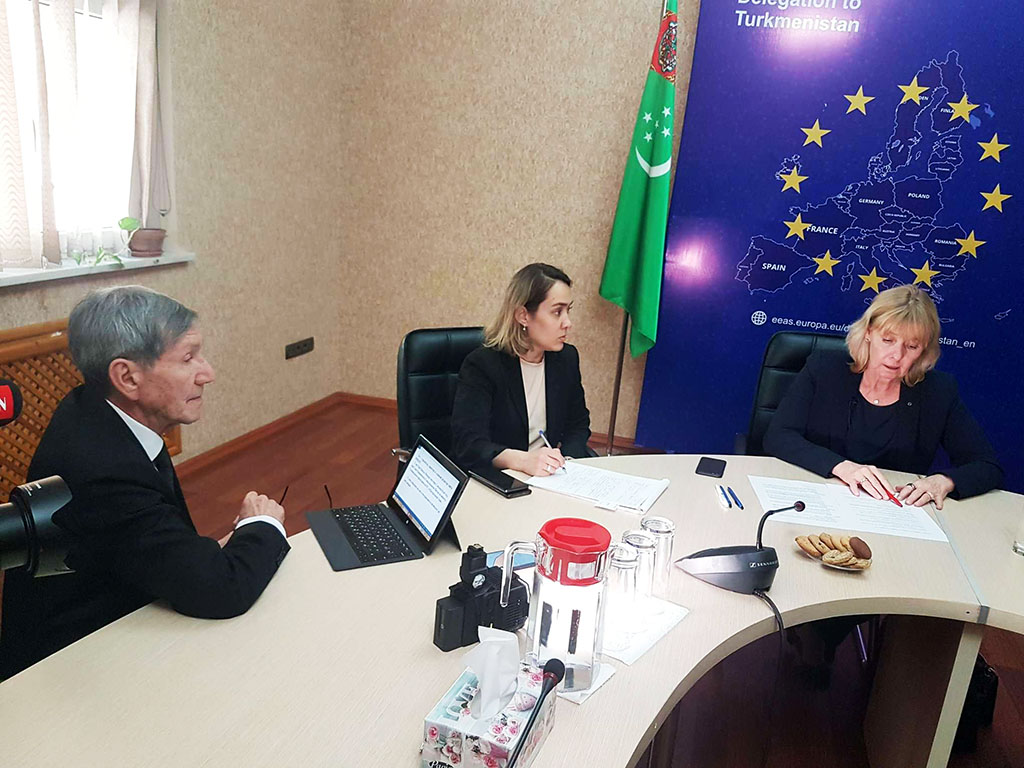
The European Union Special Representative for Central Asia, Teri Hakala, who is in Ashgabat on a working visit, gave a briefing on Thursday to representatives of the Turkmen media.
Opening the meeting with journalists, the European diplomat recalled that this was her second visit to Ashgabat as a representative of the EU - the first was in December 2021, when she took part in the forum "The policy of peace and trust - the basis of international security, stability and development." In addition, Teri Hakala visited the country several times when she worked at the Finnish Foreign Ministry.
Now, as a representative of Josep Borrell, she met with the President of Turkmenistan and the speakers of both chambers of the Turkmen parliament, the Minister of Foreign Affairs and the Deputy Prime Minister for oil and gas issues. The program of the current visit also includes a meeting with the Deputy Prime Minister for Agriculture and Environmental Protection, since, according to Hakala, she will pay special attention to water issues in her work.
Making a general statement to the press, Teri Hakala stressed that the European Union continues to be a reliable partner for Central Asia and, in particular, Turkmenistan, with which "very good bilateral relations" have been established.
The immediate plans are to intensify joint work, including within the framework of projects and programs that were “slowed down” due to the pandemic. Their topics cover sectors such as border management, drug trafficking, counter-terrorism and countering extremism, the rule of law, support for the private sector, education, health, water resources, climate, and others.
Shortly briefing journalists on the objectives of her mission, Teri Hakala answered several questions from ORIENT:
– Europe and Asia are on the same continent, and Central Asia is like a bridge between them. What role can the region play to refute Kipling's saying that West and East will never meet?

– I think that Kipling still lived in a world that is very different from the one in which we live. Globalization has changed the world and worldview, today we have global problems, global challenges. The pandemic has shown that we live in a very small world.
Of course, Asia and Europe differ geographically, climatically, culturally, but people, in fact, are the same everywhere. Central Asia plays and can play an even greater role not only as a bridge, but I would even say as a “glue”, because the peoples of this region are close to both European and Asian cultural traditions. And it will help everyone to find a common language. I hope that Central Asia will be able to fully use this voice.
– During your high-level meetings in Ashgabat, what specific measures to develop cooperation were discussed? And what economic reforms in Turkmenistan will the EU support? Are there priorities for European investment?
– We discussed many issues, both general and specific. In particular, in the aspect of facilitating the entry of Turkmenistan into the World Trade Organization, which also implies the adaptation of national legislation to the requirements of the WTO. Brussels always focuses on human rights and gender issues, which we discussed in Ashgabat as well.
In terms of the economy, the European Union as a whole supports the sustainable development of Turkmenistan. You are a rich country. You have many opportunities for economic growth, including oil and gas fields and other minerals. As for investments, I will say this: business will always find a way. The task of each country is to create such conditions that they would attract investors, and business would find its own way. For its part, the EU seeks to support all these processes, helping to create such conditions.
– How do you assess the international initiatives that Turkmenistan has put forward in recent years, including energy, transport, water diplomacy?
– All suggestions, ideas and initiatives that help improve connectivity are very important and especially relevant now. We also discussed this topic at the high-level international conference “Central and South Asia: Regional Interconnection”, which was held last summer in Tashkent. Then there was a lot of talk about the southern transport corridors, now, the so-called Middle Corridor is of interest to the EU (crosses the Caspian Sea and Central Asia - ed.).
We really appreciate that Turkmenistan actively expresses its initiatives, because the very geographical position of the country makes it an important integration link.
– Cooperation between the EU and CA covers a wide range of issues, including security. And security is a complex concept and is not limited to the borders of one state or even the borders of one region. In the case of Central Asia, Afghanistan, which has a rather long border with Turkmenistan, is always discussed in this context.
The new government that came to power in this country is ready to develop regional infrastructure projects initiated by Turkmenistan: the TAPI gas pipeline, power transmission lines and the TAP fiber optic line, railways. But now the country is under the pressure of sanctions, which are exacerbating an already deep and protracted socio-economic crisis. In your opinion, is it worth officially recognizing the Taliban government so as not to push them towards a more radical solution to the problem?

– The fact is that, as you well know, the international community has its own conditions for the recognition of the Taliban, and it is in the interests of Kabul to fulfill the requirements of the international community in order to receive international recognition. Both the European Union and all our partners, including Turkmenistan, are doing their best to support the situation so that the humanitarian situation in Afghanistan does not worsen. And here, I think, the neutrality of Turkmenistan, which has established good neighborly relations with the country, helps a lot.
The EU also sends humanitarian aid to the Afghan people, finances the salaries of employees of such vital institutions as hospitals, schools, and other social projects.
Of course, we are concerned about the situation in Afghanistan, but such conditions for the recognition of the Taliban, such as an inclusive government, respect for human rights, the possibility for girls to go to school, etc. – are also important for ensuring the stability of the country in the future.
It is in our common interests now to do everything necessary so that the population of Afghanistan can live a peaceful, dignified life, so that no one infringes on their human rights. We also have a condition so that those who want to leave Afghanistan have the opportunity to do so.
The issue of recognizing the new government of Afghanistan is a complex, international, worldwide process, and the Taliban must fulfill these conditions. We are working for this in different political formats, we are trying to influence in every possible way so that the country lives in a stable way, but respecting human rights, the rights of all ethnic groups of the population.
Bekdurdy AMANSARIEV


