Central Asian Experts Consolidate Efforts on Paris Climate Agreement
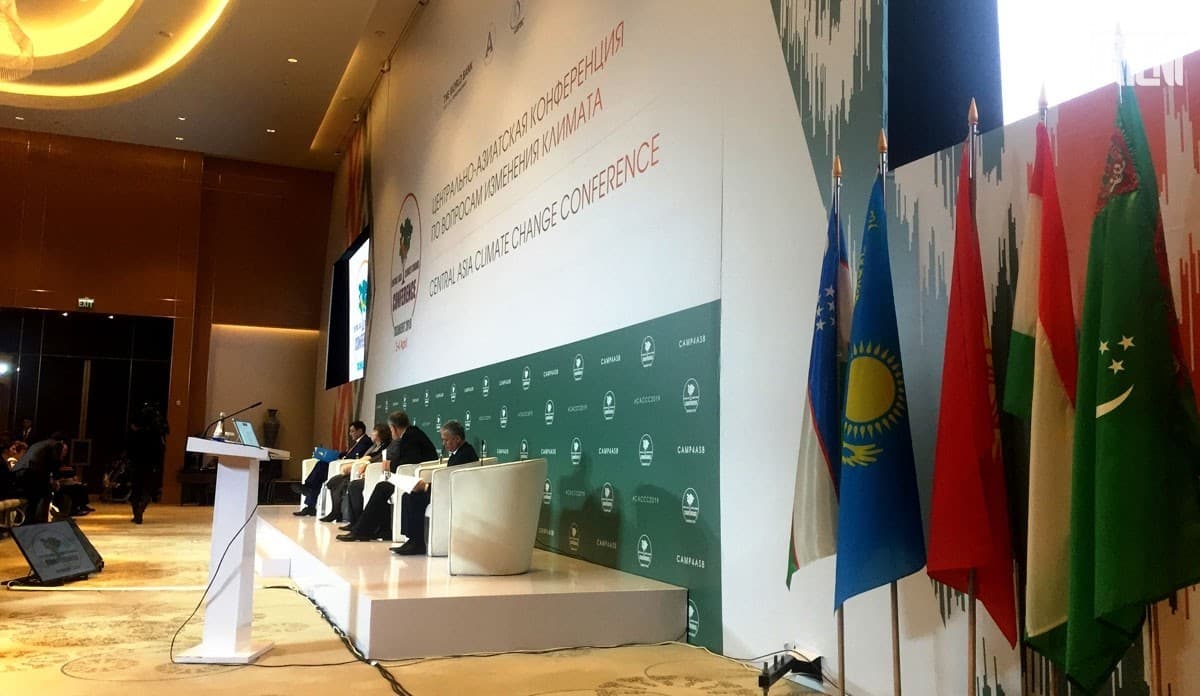
The II Central Asian Climate Change Conference (CACC) started in the capital of Uzbekistan. Representatives from countries in the region voiced national programs and actions under the Paris Agreement to counter global environmental change.
CACC, held for the second time, is becoming a popular platform for discussing climate change issues and developing relevant solutions. About 400 participants from different countries - politicians, ecologists and climate experts, representatives of youth networks - came to discuss the prospects for interstate, multisectoral dialogue, provision of high-quality climate services and climate financing.
The delegation of Turkmenistan, led by Dr. Jumamurad Saparmuradov, Head of the Department of Environmental Protection and Hydrometeorology at the Ministry of Agriculture and Environmental Protection, presented the work on mitigation and adaptation to the existing and expected conditions.
 An important issue of the conference was the discussion of the Aral problem. Guichgeldy Baijanov, Chairman of the Executive Committee of the International Fund for Saving the Aral Sea (IFAS), reported on the activities of the organization under the chairmanship of Turkmenistan and cooperation with neighbors in the region.
“Changing our actions in the field of CC is not only aimed at changing the economies of the participating countries, it is a reformatting of thinking, human perception,” said Iskandar Abdullayev, Executive Director of the Regional Environmental Center for Central Asia (CAREC). “And we hope that this conference will significantly strengthen our position in the fight against climate change.”
Within two days, the conference will review national reports on actions to adapt to climate change (CC), technologies and practices in this area, approaches to integrated management of natural resources and many other issues.
The contribution to climate change in environmental protection with the use of infrared technology is significant. The organizers refused to use paper for printing documents, booklets and the conference program, transferring all the necessary information to electronic resources - in the CACC mobile application, thanks to which anyone can get acquainted with the conference materials, speakers' presentations and the program of the event.
An important issue of the conference was the discussion of the Aral problem. Guichgeldy Baijanov, Chairman of the Executive Committee of the International Fund for Saving the Aral Sea (IFAS), reported on the activities of the organization under the chairmanship of Turkmenistan and cooperation with neighbors in the region.
“Changing our actions in the field of CC is not only aimed at changing the economies of the participating countries, it is a reformatting of thinking, human perception,” said Iskandar Abdullayev, Executive Director of the Regional Environmental Center for Central Asia (CAREC). “And we hope that this conference will significantly strengthen our position in the fight against climate change.”
Within two days, the conference will review national reports on actions to adapt to climate change (CC), technologies and practices in this area, approaches to integrated management of natural resources and many other issues.
The contribution to climate change in environmental protection with the use of infrared technology is significant. The organizers refused to use paper for printing documents, booklets and the conference program, transferring all the necessary information to electronic resources - in the CACC mobile application, thanks to which anyone can get acquainted with the conference materials, speakers' presentations and the program of the event.