Top 7 Central Asian wildlife needing protection
March 04, 2019 | 09:50 |1845
Today is World Wildlife Day. ORIENT offers readers a list of seven wild animals that live in the countries of Central Asia and need protection. The list is based on the press of the region.
Snow leopard (irbis)
 According to statistics from international environmental organizations, today the number of snow leopard species in the wild ranges from 3 to 7 thousand. On the world market, snow leopards have always been in demand and are valued very expensive. The world prey of these animals, until the widespread ban on hunting for them, did not exceed one thousand pelts per year.
The skins went mainly on the handicraft of carpets, women's fur coats, dohi and collars. For a long time, the snow leopard was considered a dangerous and harmful predator, so hunting for it was allowed year-round. For the extraction of snow leopard even issued a prize. Live snow leopards have always been in high demand, and their sale has been a profitable item of zooexport.
In 2009, President of Turkmenistan Gurbanguly Berdimuhamedov sent Vladimir Putin, who was then Prime Minister of Russia, two Persian leopards (Caucasian leopards). This was the assistance of Turkmenistan to Russia in the restoration of the population of these animals in the Caucasus.
According to statistics from international environmental organizations, today the number of snow leopard species in the wild ranges from 3 to 7 thousand. On the world market, snow leopards have always been in demand and are valued very expensive. The world prey of these animals, until the widespread ban on hunting for them, did not exceed one thousand pelts per year.
The skins went mainly on the handicraft of carpets, women's fur coats, dohi and collars. For a long time, the snow leopard was considered a dangerous and harmful predator, so hunting for it was allowed year-round. For the extraction of snow leopard even issued a prize. Live snow leopards have always been in high demand, and their sale has been a profitable item of zooexport.
In 2009, President of Turkmenistan Gurbanguly Berdimuhamedov sent Vladimir Putin, who was then Prime Minister of Russia, two Persian leopards (Caucasian leopards). This was the assistance of Turkmenistan to Russia in the restoration of the population of these animals in the Caucasus.
Horned Goat (Markhur)
 Most of the year, the horned goats stay at an altitude of 1200-2400 meters above sea level, in winter they go down below - up to 800 meters.
On the territory of post-Soviet countries, there are no more than one thousand such goats, in other countries there are much fewer. Despite the fact that hunting for these animals is universally prohibited, it does not stop poachers.
Most of the year, the horned goats stay at an altitude of 1200-2400 meters above sea level, in winter they go down below - up to 800 meters.
On the territory of post-Soviet countries, there are no more than one thousand such goats, in other countries there are much fewer. Despite the fact that hunting for these animals is universally prohibited, it does not stop poachers.
Bukhara deer
 The habitat of Bukhara deer is the territory of Central Asia. The accounts carried out on the basis of the Memorandum on the preservation of Bukhara deer, signed by Turkmenistan, Kazakhstan, Tajikistan, Kazakhstan, WWF (World Wildlife Fund), Russia and later acceding Uzbekistan, say that its number in the territories of nature reserves is increasing.
Tien Shan Brown Bear
 At present, the Tien Shan bear, previously inhabiting the mountains of Central Asia everywhere, has become rare in most areas, and in some has disappeared altogether. The Tien Shan bear was listed in the Red Book of the USSR, and now in the Red Books of all Central Asian countries.
Jeyran
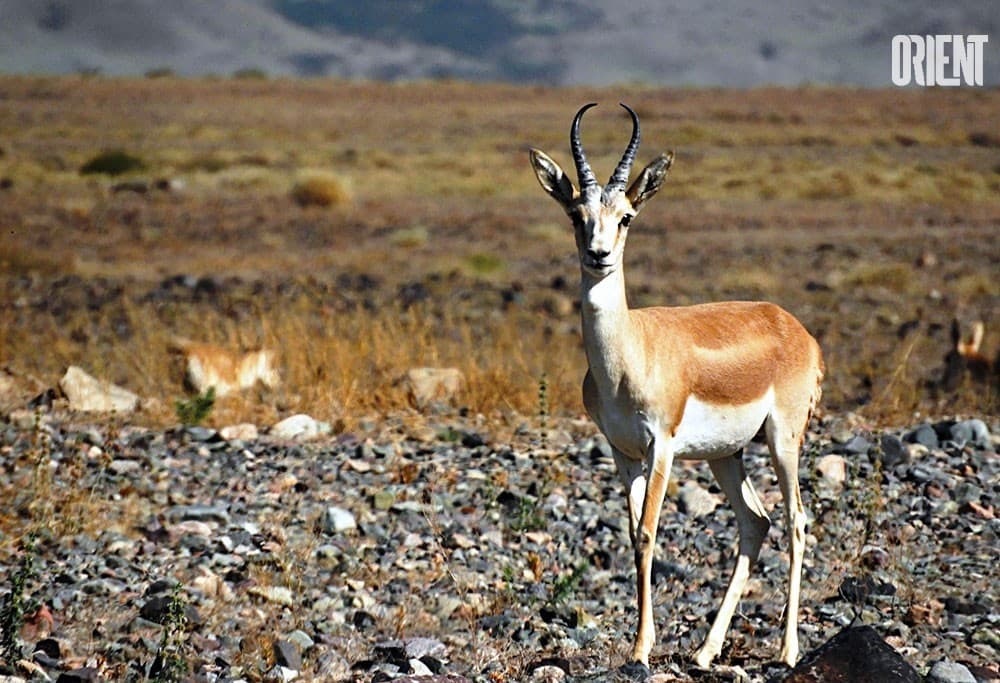
 Jeyran are very vulnerable in the wild. In the wild, they live for about 7 years, and live up to 10 years in zoos. They live in all countries of Central Asia. At the moment, gazelle has the status of an endangered animal, hunting is prohibited.
Urial
 Urial, or mountain sheep, lives on steep slopes at an altitude of 6 thousand meters above sea level. Distributed throughout Central Asia, in Pakistan, Iran and India. Mountain sheep, as well as gazelles, were objects of uncontrolled hunting..
Marco Polo Ram (Argali)
 Argali is one of the main indicator species of ungulates. The increase in its number makes it possible to save other species of wild animals. In particular, the snow leopard, one of the food objects of which is argali. At last count, the number of argali (data for 2018) is about 27 thousand heads.