Ahal-Teke horses on Red Square
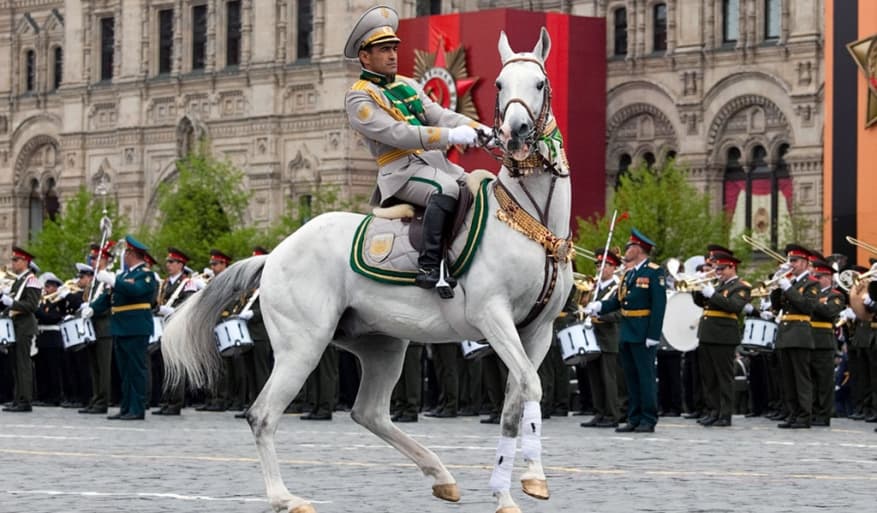
Ten years ago, in the year of the 65th anniversary of the victory in the Great Patriotic War, for the first time in post-Soviet history, not only representatives of the Russian Armed Forces, but also warriors of peoples who fought shoulder to shoulder with the Russians during the war took part in a victory parade on Red Square. Turkmenistan, which made a significant contribution to the common Victory both at the front and in the rear, was represented at the parade by soldiers of the honor guard company, whose commander pranced on the Kremlin paving on a white Ahal-Teke horse Gyrat - a relative of the legendary horse on which Marshal Zhukov hosted the Victory Parade in 1945 ...
 Marshal Zhukov's horse was born in 1930 at the horse farm of the collective farm named after K.E. Voroshilov near Ashgabat. Its genealogy originates from the famous Ag-Ishan line, which, among its ten other relatives, was recognized as one of the greatest horses of the late XIX - early XX centuries. And its ancestor, in turn, was the golden-bulan stallion Boynou, considered the ancestor of all modern lines of Ahal-Teke horse breeds.
When the stallion reached the age of two, it began to participate in the races. By the age of five, it already had a rich sports biography - it became a winner six times and won prizes in various equestrian competitions in Turkmenistan. But then its fate made a sharp turn, which ultimately led the horse to Red Square.
Marshal Zhukov's horse was born in 1930 at the horse farm of the collective farm named after K.E. Voroshilov near Ashgabat. Its genealogy originates from the famous Ag-Ishan line, which, among its ten other relatives, was recognized as one of the greatest horses of the late XIX - early XX centuries. And its ancestor, in turn, was the golden-bulan stallion Boynou, considered the ancestor of all modern lines of Ahal-Teke horse breeds.
When the stallion reached the age of two, it began to participate in the races. By the age of five, it already had a rich sports biography - it became a winner six times and won prizes in various equestrian competitions in Turkmenistan. But then its fate made a sharp turn, which ultimately led the horse to Red Square.
 In 1935, horseback ride Ashgabat-Moscow started. The path of more than 4 thousand kilometers was long and hard, therefore, the strongest and most enduring horses from all horse breeding farms of Turkmenistan were selected to participate in a unique marathon. Together with sixteen other horses, the legendary horse successfully overcame the hot sand dunes of the Karakum and Kizyl-Kum deserts, anhydrous mountain ranges, sun-scorched steppes, and, after almost three months of traveling, first proceeded along Moscow's crowded and noisy streets. Neither he nor his maned relatives have returned home. Most of the selected Ahal-Teke horses were donated to Moscow horse farms.
Then there was the Victory Parade. For many years in the Soviet Union, the old traditions of the cavalry were sacredly observed, therefore all military parades were taken on horseback, and horses were selected and prepared for this with great care. They should have been distinguished by a straight back, proud landing of their heads, harmonious forms, perfect lines, obedience to a rider, in a word, the horse should be magnificent, so that by its appearance it emphasizes the very meaning of the moment. As befits the victorious commanders, the horse must have been white. And our Ahal-Teke beauty met all these requirements. By the way, according to the documents, its suit was officially called gray, not white.
Victory Parade was a triumph of the magnificent horse. And in 1947, a middle-aged horse proved that it did not intend to give up its age and twice became the champion now in the competition for the USSR Cup and the “Higher Class”. The Ahal-Teke demonstrated the highest class by overcoming an obstacle 2 meters 12 centimeters high. It showed itself perfectly in distance runs and in the programs of officer triathlon.
In 1935, horseback ride Ashgabat-Moscow started. The path of more than 4 thousand kilometers was long and hard, therefore, the strongest and most enduring horses from all horse breeding farms of Turkmenistan were selected to participate in a unique marathon. Together with sixteen other horses, the legendary horse successfully overcame the hot sand dunes of the Karakum and Kizyl-Kum deserts, anhydrous mountain ranges, sun-scorched steppes, and, after almost three months of traveling, first proceeded along Moscow's crowded and noisy streets. Neither he nor his maned relatives have returned home. Most of the selected Ahal-Teke horses were donated to Moscow horse farms.
Then there was the Victory Parade. For many years in the Soviet Union, the old traditions of the cavalry were sacredly observed, therefore all military parades were taken on horseback, and horses were selected and prepared for this with great care. They should have been distinguished by a straight back, proud landing of their heads, harmonious forms, perfect lines, obedience to a rider, in a word, the horse should be magnificent, so that by its appearance it emphasizes the very meaning of the moment. As befits the victorious commanders, the horse must have been white. And our Ahal-Teke beauty met all these requirements. By the way, according to the documents, its suit was officially called gray, not white.
Victory Parade was a triumph of the magnificent horse. And in 1947, a middle-aged horse proved that it did not intend to give up its age and twice became the champion now in the competition for the USSR Cup and the “Higher Class”. The Ahal-Teke demonstrated the highest class by overcoming an obstacle 2 meters 12 centimeters high. It showed itself perfectly in distance runs and in the programs of officer triathlon.
* * *
Ahal-Teke is one of the oldest and most beautiful horse breeds in the world. According to scientists, its age is about five thousand years. It influenced many famous riding breeds, including the Arabian, English race, Russian horse and Don. In modern Turkmenistan, Ahal-Teke horses are considered a national treasure. It is no coincidence that the national emblem of the country depicts a long-term champion of the breed - Yanardag ("Burning Mountain"). The famous traveler Marco Polo paid tribute to the Ahal-Teke horses. In his notes, he noted that magnificent horses are bred in Turkmenistan, which are then sold for 200 livres. Marco subsequently traces the origin of the Ahal-Tekes to Bucephalus, the famous horse of Alexander the Great.
The Ahal-Teke horse is the result of the work of many generations of horse breeders in the field of breeding, a legacy of horse-breeding cultures of antiquity. Arminius Vambury, who traveled to Central Asia in the 19th century, wrote: “These beautiful animals are worth all the work they have required ... The stories of their running and endurance are not exaggerated at all.”
The famous traveler Marco Polo paid tribute to the Ahal-Teke horses. In his notes, he noted that magnificent horses are bred in Turkmenistan, which are then sold for 200 livres. Marco subsequently traces the origin of the Ahal-Tekes to Bucephalus, the famous horse of Alexander the Great.
The Ahal-Teke horse is the result of the work of many generations of horse breeders in the field of breeding, a legacy of horse-breeding cultures of antiquity. Arminius Vambury, who traveled to Central Asia in the 19th century, wrote: “These beautiful animals are worth all the work they have required ... The stories of their running and endurance are not exaggerated at all.”
ORIENT news
Sources: http://www.turkmenistan.ruhttps://cdn.orient.tm/storage/app/media/ru/node/28322 https://orient.tm/arab-belyj-kon-pobedy/ http://www.yugopolis.ru/news/social/2010/05/07/1441/9-maya-vov-marshal-jukov-parad-pobedy-konevodstvo