Folk Instruments Orchestra: Continuing Traditions
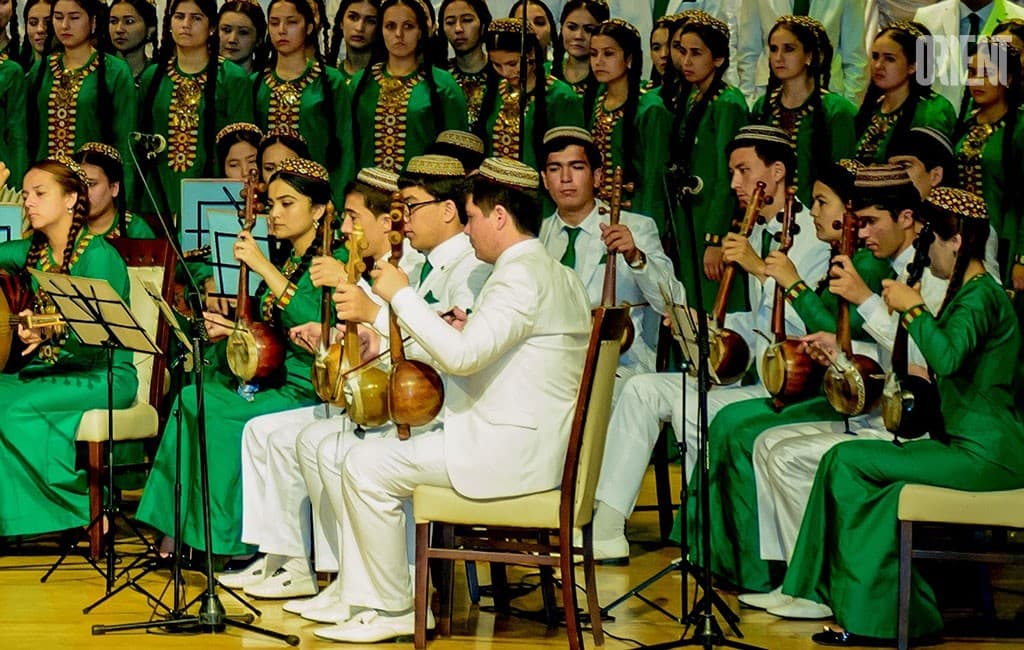
The busy season for students and teachers of the Maya Kuliyeva Turkmen National Conservatory is in progress, because spring is the time when they can show their proficiency acquired throughout the academic year. Teachers proudly present their students and personally participate in many concerts. The announcement board is hung with many posters of upcoming performances. Music of different genres sometimes sounds in large and small halls of the conservatory several times a week, and amateurs and professionals can enjoy world masterpieces.
A concert of the Conservatory’s Folk Instruments Orchestra, conducted by chief conductor, Honored Artist of Turkmenistan Omar Igamov, took place in a big hall the TNC as part of a series of all these musical events.
...The emergence of the orchestra of folk instruments goes back to the 30s of the last century. In 1933, a student orchestra was established within of the Turkmen Art College (headed by S. Tumanyan and P. Sariyev), which concert activity noticeably influenced the musical life in Ashgabat. In the same years, an orchestra of folk instruments was created on the radio. For both groups S. Tumanyan selected a repertoire, adapted folk songs and dances, arranged the works by foreign and Russian composers.
Both orchestras, having turned into highly professional groups, promoted Turkmen folk music and the best examples of classical and modern music. Being well-versed in folk instruments, Tumanyan paid much attention to the development of new and modernization of old instruments: he invented uchtar, improved timbre and overall sound of the dutar and gijak, having reconstructed them.
 Following the opening of the Turkmen department at the Moscow State Conservatory named after P.I.Tchaikovsky in 1935, every year gifted Turkmen youth were sent there. In the late 30s of the last century, the works by the first Turkmen composers appeared, which went down in the history of Turkmen musical culture. That was the time of a significant increase in Turkmen art. In 1941, an Orchestra of Turkmen Folk Instruments under the direction of G. Arakelyan was established at the State Philharmonic. Arakelyan carefully studied Turkmen folk instruments and did a lot to improve their sound. He carried out painstaking work to reconstruct them, aimed at creating families of instruments, without which the creation of an orchestra was impossible.
To enhance the orchestra sounding, Arakelyan included folk instruments of neighboring peoples into its composition, similar in sounding to those of the Turkmens: tar, kemancha, chang, nai and others. He also created the repertoire: adapting dances and melodies of the peoples of Central Asia, arranging works by Uzbek, Azerbaijani and Tajik composers, as well as his own compositions.
Even during the years of World War II, orchestras continued their activities. Their repertoire was replenished with new works created jointly by Turkmen, Russian and Ukrainian composers evacuated to Turkmenistan. But the terrible tragedy that occurred in Ashgabat in 1948 destroyed everything at one point: the earthquake took many lives, and almost all buildings were razed to the ground.
Many experts in musical art were killed, and almost all musical instruments and valuable literature were destroyed. Everything was under the rubble of collapsed buildings. Orchestras that were organized with great difficulty ceased to exist in one day. Only in 1951 was it possible to reorganize student orchestras and a music library at the Turkmen State Music College.
In 1955, the Turkmen Opera and Ballet Theater, choir, folk instrument orchestra and folk dance ensemble performed in Moscow during the decade of Turkmen literature and art.
Turkmen musical art was flourishing in the 60-70s of the twentieth century, when Turkmen composers create such large-scale works as operas, cantatas, oratorios, symphonies, symphonic poems and concerts. Composers’ work stimulated the professional growth of student groups at the music school and their expansion. These included an orchestra of folk instruments.
Following the opening of the Turkmen department at the Moscow State Conservatory named after P.I.Tchaikovsky in 1935, every year gifted Turkmen youth were sent there. In the late 30s of the last century, the works by the first Turkmen composers appeared, which went down in the history of Turkmen musical culture. That was the time of a significant increase in Turkmen art. In 1941, an Orchestra of Turkmen Folk Instruments under the direction of G. Arakelyan was established at the State Philharmonic. Arakelyan carefully studied Turkmen folk instruments and did a lot to improve their sound. He carried out painstaking work to reconstruct them, aimed at creating families of instruments, without which the creation of an orchestra was impossible.
To enhance the orchestra sounding, Arakelyan included folk instruments of neighboring peoples into its composition, similar in sounding to those of the Turkmens: tar, kemancha, chang, nai and others. He also created the repertoire: adapting dances and melodies of the peoples of Central Asia, arranging works by Uzbek, Azerbaijani and Tajik composers, as well as his own compositions.
Even during the years of World War II, orchestras continued their activities. Their repertoire was replenished with new works created jointly by Turkmen, Russian and Ukrainian composers evacuated to Turkmenistan. But the terrible tragedy that occurred in Ashgabat in 1948 destroyed everything at one point: the earthquake took many lives, and almost all buildings were razed to the ground.
Many experts in musical art were killed, and almost all musical instruments and valuable literature were destroyed. Everything was under the rubble of collapsed buildings. Orchestras that were organized with great difficulty ceased to exist in one day. Only in 1951 was it possible to reorganize student orchestras and a music library at the Turkmen State Music College.
In 1955, the Turkmen Opera and Ballet Theater, choir, folk instrument orchestra and folk dance ensemble performed in Moscow during the decade of Turkmen literature and art.
Turkmen musical art was flourishing in the 60-70s of the twentieth century, when Turkmen composers create such large-scale works as operas, cantatas, oratorios, symphonies, symphonic poems and concerts. Composers’ work stimulated the professional growth of student groups at the music school and their expansion. These included an orchestra of folk instruments.
 Going back in history and with regard to the present day, it would be desirable to note that today the student team conducted by O. Igamov is the only orchestra in Turkmenistan that includes exclusively folk instruments, i.e., not using the instruments of the symphony orchestra.
The works by Turkmen and Uzbek composers were performed in the present concert such as N. Halmammedov, B. Hudaynazarov, D. Hydyrov, A. Charyyev, K. Kuliyev, S. Mammiyev, A. Babayev, B. Zakirov, M. Bafoyev, and M. Annamuradov. Following the tradition, like the previous orchestra conductors, Omar Igamov creates the adoptions and arrangements of the works by Turkmen composers. So this concert also has a new production - N. Halmammedov’s song “Halyçy Bibi”, which was originally accompanied by a piano.
People’s Artist of Turkmenistan A. Garyagdyyev, Honored Art Worker of Turkmenistan O. Gujimov, B. Moshiyev, A. Yusupov, T. Sariyeva, B. Jumashova, B. Mashadova, G. Jumaniyazov, S. Jumamuradov took part in the concert as solo performers. .
The sound of folk instruments has always been very close and understandable to any person. And being in the large hall of the conservatory, thanks to its acoustic features, you can get extraordinary pleasure from the full and rich sound of the entire orchestra as a single mechanism, a single collective serving one idea of providing aesthetic enjoyment to the audience.
Going back in history and with regard to the present day, it would be desirable to note that today the student team conducted by O. Igamov is the only orchestra in Turkmenistan that includes exclusively folk instruments, i.e., not using the instruments of the symphony orchestra.
The works by Turkmen and Uzbek composers were performed in the present concert such as N. Halmammedov, B. Hudaynazarov, D. Hydyrov, A. Charyyev, K. Kuliyev, S. Mammiyev, A. Babayev, B. Zakirov, M. Bafoyev, and M. Annamuradov. Following the tradition, like the previous orchestra conductors, Omar Igamov creates the adoptions and arrangements of the works by Turkmen composers. So this concert also has a new production - N. Halmammedov’s song “Halyçy Bibi”, which was originally accompanied by a piano.
People’s Artist of Turkmenistan A. Garyagdyyev, Honored Art Worker of Turkmenistan O. Gujimov, B. Moshiyev, A. Yusupov, T. Sariyeva, B. Jumashova, B. Mashadova, G. Jumaniyazov, S. Jumamuradov took part in the concert as solo performers. .
The sound of folk instruments has always been very close and understandable to any person. And being in the large hall of the conservatory, thanks to its acoustic features, you can get extraordinary pleasure from the full and rich sound of the entire orchestra as a single mechanism, a single collective serving one idea of providing aesthetic enjoyment to the audience.