New artefacts have filled up a collection of archaeological finds of equestrian topic
The new artefacts which have filled up a considerable collection of archaeological finds, which are one way or another are connected with the images of horses and horse breeding, have were displayed today in Turkmenabat.
They were exhibited for review in the Lebap regional library where solemn actions on the occasion of the national holiday of the Turkmen racer took place.
Among new museum exhibits four exhibits, which serve a food for thought to historians and critics stand out. Among them the terracotta figurine covered with green glaze, representing a horseman on his horse.
 Unfortunately, the croup of the horse with its saddle and feet of the horseman has remained only, but the sculptural moulding speaks of the skilful hand of the author of this unpretentious figure. Probably, it served as a child toy, but, it is not excluded, that it had also sacral appointment as totem or object of cult. The colour of glaze, characteristic to the XII-XIV centuries, allows establishing an approximate age of this figurine.
With confident dashes of the skilled artist the head of the horse was drawn with a magnificent mane on the bottom of a ceramic vessel, also as well as a figure of the horseman found in a course of excavation at the medieval site of ancient settlement of Abiverd in Akhal region.
Unfortunately, the croup of the horse with its saddle and feet of the horseman has remained only, but the sculptural moulding speaks of the skilful hand of the author of this unpretentious figure. Probably, it served as a child toy, but, it is not excluded, that it had also sacral appointment as totem or object of cult. The colour of glaze, characteristic to the XII-XIV centuries, allows establishing an approximate age of this figurine.
With confident dashes of the skilled artist the head of the horse was drawn with a magnificent mane on the bottom of a ceramic vessel, also as well as a figure of the horseman found in a course of excavation at the medieval site of ancient settlement of Abiverd in Akhal region.
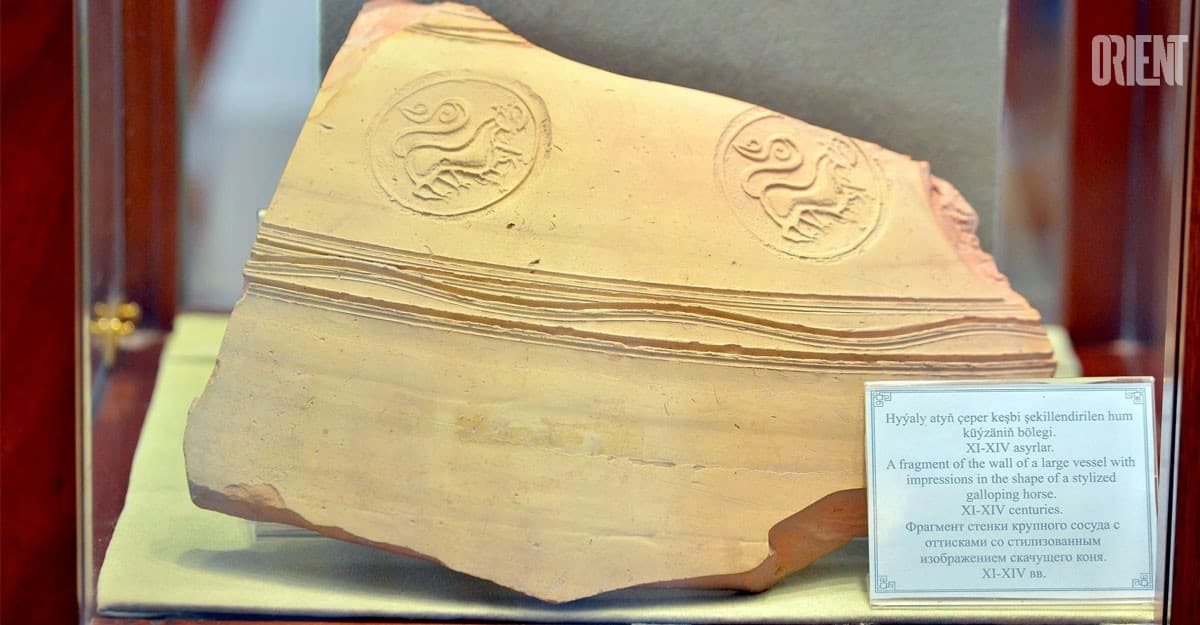
 In the same place the fragment of the wall of a large ceramic vessel on which surface deep prints made with the stylised image of a galloping horse was found. Scientists date both articles to the IX-XIV centuries when Abiverd was a prospering city on the Great Silk road.
 One more terracotta figure of a horse was unearthed at the site of ancient settlement of Murzabek in Kerki district of Lebap region. It is much more ancient, than finds from Abiverd and dates to the III-V to centuries.
 According to scientists, emergence of such figures of rude moulding on the banks of the Amu Darya during that epoch goes back to older times and their honouring as idols could be connected with that cultural environment the life of which was inconceivable without horse
These images were given a special magic force and were widespread in the territory of modern Turkmenistan and neighbouring countries during the pre-Islamic epoch.
In all times ancestors of the Türkmen tried to immortalise the image of the racing horse to what the items discovered in the cultural layers of ancient sites of the ancient settlement testify.
As known, in the country of Margush which existed about four thousand years ago on the old delta of the river Murgab, the horse had already been quite domesticated, to what the whole series of finds of the Margiana expedition under the direction of the famous archaeologist Viktor Sarianidi points out.
Besides cult burial places of these noble animals, bronze, silver and faience alarm pipes testify to it - wind musical instruments with a wide bell. In the second millennium B.C. these sonorous tools were used only for training of horses.
So, the importance of the finding is not only the fact that it again testifies that in ancient times in Margiana horses were bred not for a hard work. These were at that time still exotic enough - animals belonged, apparently, to the elite of the ancient society. Horses served ceremonial purposes, they were trained and taught for dressage.
The latest doubts of sceptics concerning horse breeding in archaic Margiana have disappeared after in one of rich tombs of the necropolis at the site of ancient settlement of Gonur-depe there was discovered a tiny bronze sculpture in the form of a horse head with a long neck, with watchful raised ears and as big eyes as the Akhalteke horse has.
This absolutely unique article with a length of all 7 centimetres was the top of a wooden staff which, of course, has decayed for thousand years under the earth. The sculpture has strongly cracked from time, but has not lost its relief and expressive outlines, with the big art transferred by the ancient master.
Professor Sarianidi was convinced that at the turn of III-II of millennia B.C. ancient tribes of Turkmenistan were already familiar with horse breeding and bred domesticated horses in their households. “It is not proved, - he wrote, - but it is extremely probable that the beginning of selection of elite breeds thereby was necessary that finally led to creation of the Akhalteke horse family tree”.
Images of racers on ancient artefacts are not a rarity among the archaeological finds which were discovered in Turkmenistan and concern the later epoch. For the native land of legendary Akhalteke horses images of the racing horse are especially symbolical.
According to scientists, emergence of such figures of rude moulding on the banks of the Amu Darya during that epoch goes back to older times and their honouring as idols could be connected with that cultural environment the life of which was inconceivable without horse
These images were given a special magic force and were widespread in the territory of modern Turkmenistan and neighbouring countries during the pre-Islamic epoch.
In all times ancestors of the Türkmen tried to immortalise the image of the racing horse to what the items discovered in the cultural layers of ancient sites of the ancient settlement testify.
As known, in the country of Margush which existed about four thousand years ago on the old delta of the river Murgab, the horse had already been quite domesticated, to what the whole series of finds of the Margiana expedition under the direction of the famous archaeologist Viktor Sarianidi points out.
Besides cult burial places of these noble animals, bronze, silver and faience alarm pipes testify to it - wind musical instruments with a wide bell. In the second millennium B.C. these sonorous tools were used only for training of horses.
So, the importance of the finding is not only the fact that it again testifies that in ancient times in Margiana horses were bred not for a hard work. These were at that time still exotic enough - animals belonged, apparently, to the elite of the ancient society. Horses served ceremonial purposes, they were trained and taught for dressage.
The latest doubts of sceptics concerning horse breeding in archaic Margiana have disappeared after in one of rich tombs of the necropolis at the site of ancient settlement of Gonur-depe there was discovered a tiny bronze sculpture in the form of a horse head with a long neck, with watchful raised ears and as big eyes as the Akhalteke horse has.
This absolutely unique article with a length of all 7 centimetres was the top of a wooden staff which, of course, has decayed for thousand years under the earth. The sculpture has strongly cracked from time, but has not lost its relief and expressive outlines, with the big art transferred by the ancient master.
Professor Sarianidi was convinced that at the turn of III-II of millennia B.C. ancient tribes of Turkmenistan were already familiar with horse breeding and bred domesticated horses in their households. “It is not proved, - he wrote, - but it is extremely probable that the beginning of selection of elite breeds thereby was necessary that finally led to creation of the Akhalteke horse family tree”.
Images of racers on ancient artefacts are not a rarity among the archaeological finds which were discovered in Turkmenistan and concern the later epoch. For the native land of legendary Akhalteke horses images of the racing horse are especially symbolical.