A friend and a defender
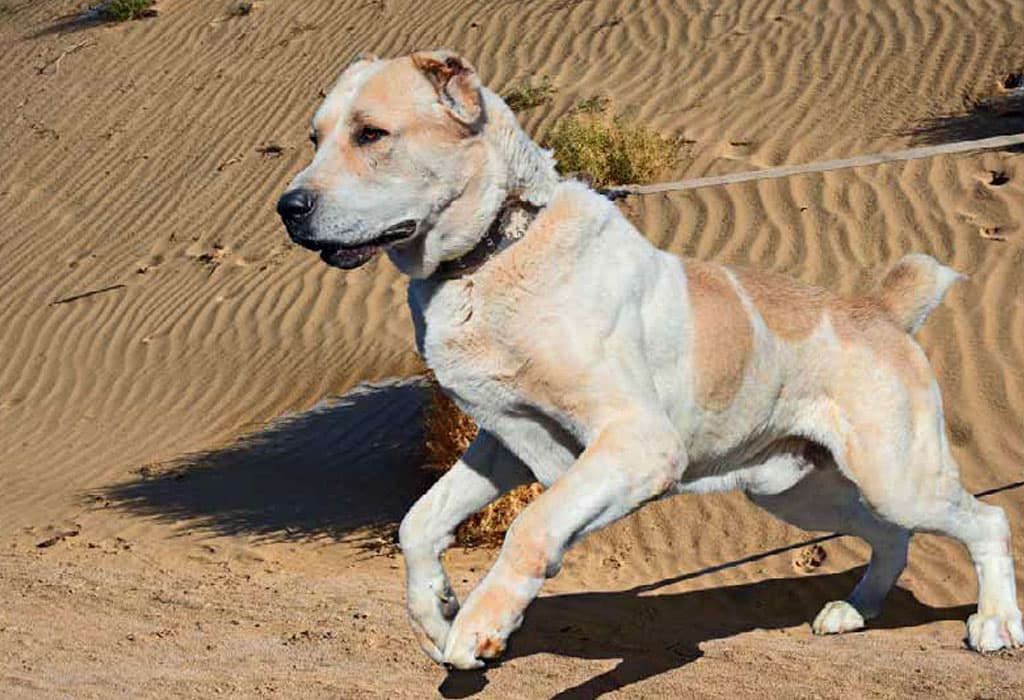
Boundless sands of the Kara Kum and the one who grazes a flock of sheep. Everyone, who lives in Turkmenistan, this picture is perfectly familiar. But, if one has a look, on the nearest hillock or any other natural mound nearby it is possible to notice a silhouette of a large dog, as though having a rest and nothing noticing around.
But this affected impressiveness is deceptive. The semi-closed eyes attentively examine all around, nice ears startle and react to the slightest rustles of the desert, and the big black nostrils hardly considerably move, finding in a dense interlacing of smells that speak about the approach of a stranger.
And then, whether it is a hyena, a steppe lynx - desert lynx or the most dangerous predator in the desert – a wolf, a dog will fearlessly enter with them into fight from which only one can come out a winner. Another way simply cannot be, after all the problem of a dog - to protect entrusted to it by the owner of animals, property, a family and children.
You ask what is the breed for? And I with pride will present it to you - get acquainted, it is the Central Asian sheep-dog or alabay.
 The history of this breed totals more than four thousand years. There is a legend that a Tibetan mastiff, having appeared at first in China, and then in Central Asia, began to be crossed by local breeds of dog therefore there appeared the present alabay. Whether it was so actually - it is for certain not known, but the first written sources of the breed are dated to the XI century.
The Caucasian sheep-dog, Spanish mastiff, Italian Maremma - all of them can be close relatives of the alabay. Dog breeders mark not only external similarity, but also similarity in habits. It is quite probably that they came out from the species which were taken to Europe together with sold herds of the cattle. There is also an opinion that they are descendants of the alabay, protecting caravans on the Great Silk road.
Today the breeding of thoroughbred Turkmen alabays and preservation of everything inherent in this breed, qualities the steadfast attention is given by the state.
The history of this breed totals more than four thousand years. There is a legend that a Tibetan mastiff, having appeared at first in China, and then in Central Asia, began to be crossed by local breeds of dog therefore there appeared the present alabay. Whether it was so actually - it is for certain not known, but the first written sources of the breed are dated to the XI century.
The Caucasian sheep-dog, Spanish mastiff, Italian Maremma - all of them can be close relatives of the alabay. Dog breeders mark not only external similarity, but also similarity in habits. It is quite probably that they came out from the species which were taken to Europe together with sold herds of the cattle. There is also an opinion that they are descendants of the alabay, protecting caravans on the Great Silk road.
Today the breeding of thoroughbred Turkmen alabays and preservation of everything inherent in this breed, qualities the steadfast attention is given by the state.
 In October, 2019 by the decision of President of Turkmenistan Gurbanguly Berdimuhamedov economic society «Türkmen alabaý itleri» («Turkmen alabays»), called to carry out an active work on selection and breed of the Central Asian sheep-dogs. And a month before at the meeting of the Cabinet of Ministers the head of the state informed on the release of the new book devoted to the Turkmen alabay. The book «Türkmen alabaýy» («Turkmen alabay»), growing out of generalisation of a large quantity of research and scientific material, not simply tells about the origin and development of the well-known breed of the dog, one of the most oldest in the world, but opens a cultural phenomenon of the Turkmen sheep-dog.
How the modern alabay does looks like? What are standards of this breed?
All who is familiar with these dogs mark its beauty and courage, a powerful constitution, nobleness of movements, confidence and calmness. Throughout centuries Turkmen shepherds made some kind of natural selection, leaving for themselves the most courageous and resolute species which came out winners in fights. After all the main task of the alabay is to protect a flock and to drive away, but ideally to tear to pieces any predator, dared to come nearer the property of the owner.
In October, 2019 by the decision of President of Turkmenistan Gurbanguly Berdimuhamedov economic society «Türkmen alabaý itleri» («Turkmen alabays»), called to carry out an active work on selection and breed of the Central Asian sheep-dogs. And a month before at the meeting of the Cabinet of Ministers the head of the state informed on the release of the new book devoted to the Turkmen alabay. The book «Türkmen alabaýy» («Turkmen alabay»), growing out of generalisation of a large quantity of research and scientific material, not simply tells about the origin and development of the well-known breed of the dog, one of the most oldest in the world, but opens a cultural phenomenon of the Turkmen sheep-dog.
How the modern alabay does looks like? What are standards of this breed?
All who is familiar with these dogs mark its beauty and courage, a powerful constitution, nobleness of movements, confidence and calmness. Throughout centuries Turkmen shepherds made some kind of natural selection, leaving for themselves the most courageous and resolute species which came out winners in fights. After all the main task of the alabay is to protect a flock and to drive away, but ideally to tear to pieces any predator, dared to come nearer the property of the owner.
 Here all matters - both the position of paws, and thorax width, both the volume of lungs, and a strong neck. The alabay should have a massive heavy head with smooth transition from the forehead to muzzle, reminding the head of a polar bear – as told by experts.
Despite their terrible appearance, the Central Asian sheep-dog possesses the sensitive heart and is able to appreciate a good relation to itself. Make friends with the Turkmen alabay and you will not find more devoted and loyal friend and defender. It is kind with children and frequently becomes a real «member of the family».
The alabay has a very steady mentality, it is patient, but, nevertheless, one should not anger it. It is quite capable to stand for itself and for its owner. The dog easily adapts to new conditions and never barks in vain.
The wool of the Turkmen sheep-dog is rough and direct, with a dense underfur. The height at the shoulder not be less than 65 sm, and separate representatives of the breed weigh 100 kg.
Here all matters - both the position of paws, and thorax width, both the volume of lungs, and a strong neck. The alabay should have a massive heavy head with smooth transition from the forehead to muzzle, reminding the head of a polar bear – as told by experts.
Despite their terrible appearance, the Central Asian sheep-dog possesses the sensitive heart and is able to appreciate a good relation to itself. Make friends with the Turkmen alabay and you will not find more devoted and loyal friend and defender. It is kind with children and frequently becomes a real «member of the family».
The alabay has a very steady mentality, it is patient, but, nevertheless, one should not anger it. It is quite capable to stand for itself and for its owner. The dog easily adapts to new conditions and never barks in vain.
The wool of the Turkmen sheep-dog is rough and direct, with a dense underfur. The height at the shoulder not be less than 65 sm, and separate representatives of the breed weigh 100 kg.
 In the territory of modern Turkmenistan an attitude to this breed of the dog was always especial and much information attests to it. It is finds from Altyn-depe and Gonurdepe sites- terracotta figures of dogs with short-cut ears and tail, and a ritual burial place of the alabay, found in Margiana in Mary region. There are images of huge dogs on one of the Parthian rythons - vessels for drinking in the shape of horn - from Old Nyssa.
Besides magnificent shepherd's skills, Turkmen alabay successfully bears guard duty in frontier troops and protection of various objects.
It is interesting that the knack for protection is not typical of every dog and this ability exclusively genetically is transferred.
Shepherds know that the real Turkmen alabay at the subconscious level feels that one of the sheep in its herd gave a birth and all the night long remains with it and a new-born lamb, protecting them against a possible attack. And in the morning it sees them off to the herd, carrying out its centuries old requirement developed in its genes - to protect and defend.
In the territory of modern Turkmenistan an attitude to this breed of the dog was always especial and much information attests to it. It is finds from Altyn-depe and Gonurdepe sites- terracotta figures of dogs with short-cut ears and tail, and a ritual burial place of the alabay, found in Margiana in Mary region. There are images of huge dogs on one of the Parthian rythons - vessels for drinking in the shape of horn - from Old Nyssa.
Besides magnificent shepherd's skills, Turkmen alabay successfully bears guard duty in frontier troops and protection of various objects.
It is interesting that the knack for protection is not typical of every dog and this ability exclusively genetically is transferred.
Shepherds know that the real Turkmen alabay at the subconscious level feels that one of the sheep in its herd gave a birth and all the night long remains with it and a new-born lamb, protecting them against a possible attack. And in the morning it sees them off to the herd, carrying out its centuries old requirement developed in its genes - to protect and defend.
 Now the alabay is one of the most popular breeds of the dog in the world and in spite of the fact that in many other countries there are nurseries for development of the Central Asian sheep-dog, in Turkmenistan to the greatest extent its protogenic qualities and appearance have preserved.
Standards of the breed of the Turkmen sheep-dog were as early as 1976 and in 1990 in Turkmenistan they were elaborated according to modern norms and took a final shape.
In the book «Turkmen alabays» Gurbanguly Berdimuhamedov provides the words of the famous Russian cynologist and international expert G.M.Charyhov who in 2001 confirmed: «These dogs – the gold fund of Turkmenistan. Development of this breed is the result of rather long, laborious, purposeful work of many generations. To bring up the alabay which will correspond to all requirements is very difficult task. Therefore, their owners consider it wrong to put the alabay at one level with other dogs, including with thoroughbred Central Asian sheep-dogs which are used only for cattle protection. Undoubtedly, it can offend and make angry them. But it is fair».
Now the alabay is one of the most popular breeds of the dog in the world and in spite of the fact that in many other countries there are nurseries for development of the Central Asian sheep-dog, in Turkmenistan to the greatest extent its protogenic qualities and appearance have preserved.
Standards of the breed of the Turkmen sheep-dog were as early as 1976 and in 1990 in Turkmenistan they were elaborated according to modern norms and took a final shape.
In the book «Turkmen alabays» Gurbanguly Berdimuhamedov provides the words of the famous Russian cynologist and international expert G.M.Charyhov who in 2001 confirmed: «These dogs – the gold fund of Turkmenistan. Development of this breed is the result of rather long, laborious, purposeful work of many generations. To bring up the alabay which will correspond to all requirements is very difficult task. Therefore, their owners consider it wrong to put the alabay at one level with other dogs, including with thoroughbred Central Asian sheep-dogs which are used only for cattle protection. Undoubtedly, it can offend and make angry them. But it is fair».
 Further the expert-dog breeder suggests naming alabays Turkmen wolfhounds and now this name often enough meets in many sources.
Alabay is really national pride of the Turkmen people, legends and traditions which are handed down from generation to generation, many of which are given in the book «Turkmen alabay» also attest to it.
«In ancient times one settlement was attacked by enemies. It was a big tragedy when inhabitants of the village were killed. In the ruined village alabays shared the sufferings, fallen onto the lot of their owners. None of dogs left the village».
«Other legend says that alabay did not let any stranger enter the village. The people who left their houses for earnings, the horse was a companion and friend, and their houses were protected by the devoted alabays Sometimes in the village there were only women and small children. But in the village on the outskirts of which would sit alabays and watch passers-by and strangers with their sharp-sights not to let them enter the village».
«In one settlement there lived a very beautiful girl. A young man-gumli fell in love with her, but could not meet her in any way. He strongly suffered. Suddenly an idea came to his head, he decided to present Akgush whom he had grown up himself, to people of that settlement, with a hope to meet the girl. Elders of the village, without guessing plans of the young man, decided to give a dog into good hands, the family of that girl. Unrealizable dreams of the young man came true in a flash. He had a possibility to see his beloved, visiting from time to time the alabay. So, Akgush helped the owner, young man-gumli to realize his dream».
Further the expert-dog breeder suggests naming alabays Turkmen wolfhounds and now this name often enough meets in many sources.
Alabay is really national pride of the Turkmen people, legends and traditions which are handed down from generation to generation, many of which are given in the book «Turkmen alabay» also attest to it.
«In ancient times one settlement was attacked by enemies. It was a big tragedy when inhabitants of the village were killed. In the ruined village alabays shared the sufferings, fallen onto the lot of their owners. None of dogs left the village».
«Other legend says that alabay did not let any stranger enter the village. The people who left their houses for earnings, the horse was a companion and friend, and their houses were protected by the devoted alabays Sometimes in the village there were only women and small children. But in the village on the outskirts of which would sit alabays and watch passers-by and strangers with their sharp-sights not to let them enter the village».
«In one settlement there lived a very beautiful girl. A young man-gumli fell in love with her, but could not meet her in any way. He strongly suffered. Suddenly an idea came to his head, he decided to present Akgush whom he had grown up himself, to people of that settlement, with a hope to meet the girl. Elders of the village, without guessing plans of the young man, decided to give a dog into good hands, the family of that girl. Unrealizable dreams of the young man came true in a flash. He had a possibility to see his beloved, visiting from time to time the alabay. So, Akgush helped the owner, young man-gumli to realize his dream».
 One of the Turkmen proverbs says: «Husband should be strong, the cattle should be full and alabay should be brave».
One can bring a great number of examples of such quivering and special relation of the Turkmen to the alabay where the dog shows all the best, it is possible to say “human" qualities. It is for certain known that in hard times alabays also continued to protect the livestock, share hunger and deprivations together with people, without leaving its place of “duty” not for a minute.
One of the Turkmen proverbs says: «Husband should be strong, the cattle should be full and alabay should be brave».
One can bring a great number of examples of such quivering and special relation of the Turkmen to the alabay where the dog shows all the best, it is possible to say “human" qualities. It is for certain known that in hard times alabays also continued to protect the livestock, share hunger and deprivations together with people, without leaving its place of “duty” not for a minute.
 But how it is possible to get acquainted more closely with this surprising breed of the dog where it is possible to learn such facts and data, many of which do not meet in the open spaces of the Internet and do not wander from pages to pages of newspapers and magazines? Certainly, only visiting the professional breeder of alabays and the person who has put all his soul in selection and cultivation of this breed.
I went to Dovletmurad Kurrikov who was till 2016 the chairman of cynology club «Türkmen iti», and since 2017 has headed the section for breeding of alabays of the club of Turkmen cynologists “Buysanch" and simultaneously works as chief judge for test experiments of Turkmen wolfhounds.
- Not at all, I am not a hereditary "dog lover", - Dovletmurad Ataevich laughs. - My parents never held dogs and only at the age of ten, studying in the first form, I could not pass by two puppies plaintively whining in a manhole, and rescued them.
But how it is possible to get acquainted more closely with this surprising breed of the dog where it is possible to learn such facts and data, many of which do not meet in the open spaces of the Internet and do not wander from pages to pages of newspapers and magazines? Certainly, only visiting the professional breeder of alabays and the person who has put all his soul in selection and cultivation of this breed.
I went to Dovletmurad Kurrikov who was till 2016 the chairman of cynology club «Türkmen iti», and since 2017 has headed the section for breeding of alabays of the club of Turkmen cynologists “Buysanch" and simultaneously works as chief judge for test experiments of Turkmen wolfhounds.
- Not at all, I am not a hereditary "dog lover", - Dovletmurad Ataevich laughs. - My parents never held dogs and only at the age of ten, studying in the first form, I could not pass by two puppies plaintively whining in a manhole, and rescued them.
 Being afraid that the father would not allow leaving them at home, small Dovletmurad secretly carried meal from his plate to it and his grandfather quickly noticed it. Having asked the little boy, old and wise elderly man promised to talk to the father of Dovletmurad and he kept his word. Puppies were moved to the yard and one of them lived very long and became a true friend and pride of Dovletmurad, though the dog was not a thoroughbred alabay. That was how all that began.
For Dovletmurad I had many questions and I asked him to begin the story with the very first what the cynologist - from occurrence of an issue of the alabay.
It appeared that the Central Asian sheep-dog can give birth to 17 puppies, and all of them, as a rule, grow healthy.
Being afraid that the father would not allow leaving them at home, small Dovletmurad secretly carried meal from his plate to it and his grandfather quickly noticed it. Having asked the little boy, old and wise elderly man promised to talk to the father of Dovletmurad and he kept his word. Puppies were moved to the yard and one of them lived very long and became a true friend and pride of Dovletmurad, though the dog was not a thoroughbred alabay. That was how all that began.
For Dovletmurad I had many questions and I asked him to begin the story with the very first what the cynologist - from occurrence of an issue of the alabay.
It appeared that the Central Asian sheep-dog can give birth to 17 puppies, and all of them, as a rule, grow healthy.
 When kids reach five days, their ears and tails are cut. For this purpose there are two principal causes: first, a tail and ears are the weakest spots of any dog, giving a chance of victory to the uninvited predator that approaches a flock of sheep. And secondly, short ears aggravate hearing of alabay and the short-cut tail does not allow decreasing the sense of smell, after all many dogs instinctively during sleeping cover the lobe of their noses with tails.
At the age of two months the puppy should receive all necessary complex inoculations as then they have the change of their teeth and the loss of calcium subsequently in the organism of a dog leads to the time stop of growth. Approximately since four months to six-seven young alabay practically does not grow. But then, up to achievement of eleven month age, the dog grows every day fast and approximately to two-year term it is considered completely generated and ripened both to posterity reproduction, and to participation in tests.
It is necessary to dwell upon the last one.
We already know that the main mission of the alabay is protection and defence; it is the basic working qualities of the real Central Asian sheep-dog. The dogs, incapable to reject pressure of the biped or four-footed opponent, are not considered as true alabay and, whatever titles they possess, they usually are not involved in breeding.
For an estimation of working qualities of the Central Asian sheep-dog in places of their primordial cultivation fights are organized accurately by established rules which exclude traumas and, especially, loss of dogs. Today such actions have received the name «Test of alabays».
- Test of our sheep-dogs is the test of their character, strength of mind of the breed and physical qualities, - Dovletmurad Kurrikov says. – for them we, judges and fans of these dogs, choose best of the best, goes some kind of selection for the purpose of improvement of pedigree qualities.
By what criteria selection is carried out? They are mainly only four:
When kids reach five days, their ears and tails are cut. For this purpose there are two principal causes: first, a tail and ears are the weakest spots of any dog, giving a chance of victory to the uninvited predator that approaches a flock of sheep. And secondly, short ears aggravate hearing of alabay and the short-cut tail does not allow decreasing the sense of smell, after all many dogs instinctively during sleeping cover the lobe of their noses with tails.
At the age of two months the puppy should receive all necessary complex inoculations as then they have the change of their teeth and the loss of calcium subsequently in the organism of a dog leads to the time stop of growth. Approximately since four months to six-seven young alabay practically does not grow. But then, up to achievement of eleven month age, the dog grows every day fast and approximately to two-year term it is considered completely generated and ripened both to posterity reproduction, and to participation in tests.
It is necessary to dwell upon the last one.
We already know that the main mission of the alabay is protection and defence; it is the basic working qualities of the real Central Asian sheep-dog. The dogs, incapable to reject pressure of the biped or four-footed opponent, are not considered as true alabay and, whatever titles they possess, they usually are not involved in breeding.
For an estimation of working qualities of the Central Asian sheep-dog in places of their primordial cultivation fights are organized accurately by established rules which exclude traumas and, especially, loss of dogs. Today such actions have received the name «Test of alabays».
- Test of our sheep-dogs is the test of their character, strength of mind of the breed and physical qualities, - Dovletmurad Kurrikov says. – for them we, judges and fans of these dogs, choose best of the best, goes some kind of selection for the purpose of improvement of pedigree qualities.
By what criteria selection is carried out? They are mainly only four:
 Judges during tests reveal dogs who snap at opponents exclusively in the area of the head that is correct for behaviour of alabay in fight. Besides, the real wolfhound should not unclench the grasp ahead of time. The grasp from the throat which is the most vulnerable part of a body of the majority of the predators living in nature is desirable. It is not an exception for a wolf occupying deserted areas of Turkmenistan. And, at last, the competent jury watches closely that alabay “pull down" the opponent exclusively on one side and not on the back at all. Otherwise the frightened animal can put serious mutilations with its claws in the area of the stomach of the dog.
During tests they select those representatives of the breed which are least sensitive to pain and are not inclined to surrender, those which always go to the victorious end. Such alabays also create a basis of unique genofund of which by right Turkmen nationals are proud.
Dovletmurad told that for these years he has grown many worthy representatives of the breed, his dogs often participate in various competitions abroad, in particular in Russia, Kazakhstan, Uzbekistan where occupy prize-winning places and become champions in their categories.
In order to achieve all it, alabay should daily practice physical activities, have right care and food. Receiving all this, the Turkmen sheep-dog lives on average for 12-14 years.
Now Dovletmurad Kurrikov has fifteen (!) alabays, each of which is the bright representative of this surprising and unique Turkmen breed of the dog.
Leaving his hospitable house, I who were born and have lived all my life in Turkmenistan, have caught myself on the thought that I have had another look at the so well familiar dog breed to me since my childhood and it is sinful to conceal, I have really fallen in love with it.
And there can hardly be another way, after all Turkmen alabay is not simple a breed of the dog; it is the whole layer in the history of Turkmen people, a part of its original and unique culture. Without which it is impossible to imagine Turkmenistan, Turkmen nationals.
Judges during tests reveal dogs who snap at opponents exclusively in the area of the head that is correct for behaviour of alabay in fight. Besides, the real wolfhound should not unclench the grasp ahead of time. The grasp from the throat which is the most vulnerable part of a body of the majority of the predators living in nature is desirable. It is not an exception for a wolf occupying deserted areas of Turkmenistan. And, at last, the competent jury watches closely that alabay “pull down" the opponent exclusively on one side and not on the back at all. Otherwise the frightened animal can put serious mutilations with its claws in the area of the stomach of the dog.
During tests they select those representatives of the breed which are least sensitive to pain and are not inclined to surrender, those which always go to the victorious end. Such alabays also create a basis of unique genofund of which by right Turkmen nationals are proud.
Dovletmurad told that for these years he has grown many worthy representatives of the breed, his dogs often participate in various competitions abroad, in particular in Russia, Kazakhstan, Uzbekistan where occupy prize-winning places and become champions in their categories.
In order to achieve all it, alabay should daily practice physical activities, have right care and food. Receiving all this, the Turkmen sheep-dog lives on average for 12-14 years.
Now Dovletmurad Kurrikov has fifteen (!) alabays, each of which is the bright representative of this surprising and unique Turkmen breed of the dog.
Leaving his hospitable house, I who were born and have lived all my life in Turkmenistan, have caught myself on the thought that I have had another look at the so well familiar dog breed to me since my childhood and it is sinful to conceal, I have really fallen in love with it.
And there can hardly be another way, after all Turkmen alabay is not simple a breed of the dog; it is the whole layer in the history of Turkmen people, a part of its original and unique culture. Without which it is impossible to imagine Turkmenistan, Turkmen nationals.
Viktor Kardashov