Archaeological exhibits of the museums in Turkmenistan will be replenished with new finds
At a meeting of the Turkmen Government on November 22, Deputy Prime Minister Bahargul Abdiyeva informed President Gurbanguly Berdimuhamedov on the seasonal archaeological excavations results conducted in 2019 within three historical and cultural reserves, and the upcoming transfer of the discovered finds to the country’s museums.
 Employees of the National Department for the Protection, Study and Restoration of Historical and Cultural Monuments at the Institute of History and Archeology of the Academy of Sciences of Turkmenistan during the field work of their expeditions discovered artifacts that will now replenish the funds of three regional museums in Anau, Mary and Turkmenabat. These are the Ak Bugday National Museum in Akhal and the History and Local Lore Museums in Lebap and Mary Regions. A public presentation of the new finds is to be held on the eve of the International Day of Neutrality, celebrated on December 12.
 The finds discovered in Abiverd, a medieval city which ruins are located on the western outskirts of Kaahka in Akhal Velayat include are several varieties of ceramic dishes of the Seljuk and Timurid periods such as a glazed dish with decorative painting in the form of a chess board, absolutely intact pieces of bowls and cups of the 14th-15th centuries of different shapes and sizes.
 Several so-called spherical cones (ceramic bottles for storing mercury with very thick walls and a small hole), which are easy to plug with a cork, have replenished a large collection of these elegant gabled containers, very popular in time of the Great Silk Road.
 Almost one meter high big ceramic rings with an egg-shaped outline, found in Abiverd, were used as links in an underground water tunnel. These parts of the ancient kyariz testify to the high engineering level of the local craftsmen who created the hydraulic engineering structure supplying the well-fortified city with water from the springs in the Kopetdag foothills.
 A bronze pin with a topping in the form of a waterfowl figurine provokes particular interest. Such products were widespread even in the Bronze Age about four thousand years ago: many specimens with different toppings were found in ancient Margiana, but the discovery of such a pin in Abiverd was much unexpected, and may be associated with huge Namazga-depe settlement located in the neighborhood. By age it is even older than the monuments of Margush State, and, according to its discoverer Viktor Sarianidi, it was Namazga from where the tribes moved to the Murgab delta and founded such proto-cities as Gonurdepe. The found pin with a bird is another good argument in favor of this hypothesis.
Another remarkable find was discovered by the staff of the Abiverd State Historical and Cultural Reserve. During archaeological excavation of the floor inside the famous Mane-baba Mausoleum in order to study the multilayer structure of the coating and clarify the dates of repair works that had been carried out there throughout many centuries, the researchers discovered a handful of coins in the 13th century cultural layer.
A bronze pin with a topping in the form of a waterfowl figurine provokes particular interest. Such products were widespread even in the Bronze Age about four thousand years ago: many specimens with different toppings were found in ancient Margiana, but the discovery of such a pin in Abiverd was much unexpected, and may be associated with huge Namazga-depe settlement located in the neighborhood. By age it is even older than the monuments of Margush State, and, according to its discoverer Viktor Sarianidi, it was Namazga from where the tribes moved to the Murgab delta and founded such proto-cities as Gonurdepe. The found pin with a bird is another good argument in favor of this hypothesis.
Another remarkable find was discovered by the staff of the Abiverd State Historical and Cultural Reserve. During archaeological excavation of the floor inside the famous Mane-baba Mausoleum in order to study the multilayer structure of the coating and clarify the dates of repair works that had been carried out there throughout many centuries, the researchers discovered a handful of coins in the 13th century cultural layer.
 Lying for many centuries in moisture, coins oxidized, stuck together and could not be read. After thorough cleaning under laboratory conditions, it was possible to identify that these are silver dirhams of various coinage. A total of 91 silver coins were found, 47 having an inscription with the name of Abag Khan who ruled the State of Ilkhanids in 1265-1282. Other 36 coins had the name of Argun. Two prominent historical figures were known with this name at that time: Argun Khan, who ruled the State of Ilkhanids in 1284-1291, and Turkmen Argun Shah, who ruled Khorasan with a residence in Merv.
Two coins with the name of Argun Khan attracted special attention of numismatists. There are images of animals on their back: it is possible to see the outlines of a lion on one and a creature that looks like a bull on the other. According to experts, such zoomorphic motifs were especially characteristic of the mints of large cities of Khorasan at that time. Perhaps these images marked the year according to the eastern calendar of the twelve-year animal cycle in which they were minted.
Other eight dirham coins also relate to the Ilkhanid State, but it is not possible to read the precise name of the ruler. It is probable that this could be Chingizid Gazan Khan, who, according to Rashid ad-Din, having adopted Islam, made a pilgrimage to the tomb of holy elder Sheikh Abu Said Abul Khayr (Mane-baba) and ordered to reconstruct the mausoleum. It was then that an amazing tiled mosaic appeared on the portal of his monument.
Lying for many centuries in moisture, coins oxidized, stuck together and could not be read. After thorough cleaning under laboratory conditions, it was possible to identify that these are silver dirhams of various coinage. A total of 91 silver coins were found, 47 having an inscription with the name of Abag Khan who ruled the State of Ilkhanids in 1265-1282. Other 36 coins had the name of Argun. Two prominent historical figures were known with this name at that time: Argun Khan, who ruled the State of Ilkhanids in 1284-1291, and Turkmen Argun Shah, who ruled Khorasan with a residence in Merv.
Two coins with the name of Argun Khan attracted special attention of numismatists. There are images of animals on their back: it is possible to see the outlines of a lion on one and a creature that looks like a bull on the other. According to experts, such zoomorphic motifs were especially characteristic of the mints of large cities of Khorasan at that time. Perhaps these images marked the year according to the eastern calendar of the twelve-year animal cycle in which they were minted.
Other eight dirham coins also relate to the Ilkhanid State, but it is not possible to read the precise name of the ruler. It is probable that this could be Chingizid Gazan Khan, who, according to Rashid ad-Din, having adopted Islam, made a pilgrimage to the tomb of holy elder Sheikh Abu Said Abul Khayr (Mane-baba) and ordered to reconstruct the mausoleum. It was then that an amazing tiled mosaic appeared on the portal of his monument.
 Further excavations in Dandanakan, a small medieval town on the old caravan route from Sarakhs to Merv, have resulted in many new finds this year as well. These include an absolutely intact ceramic jug with a large handle and a narrow neck, parts of a loom, bronze, iron and stone utensils. The most notable of them is keser of the 11th-12th centuries (a small metal knife for cutting pile when weaving a carpet.
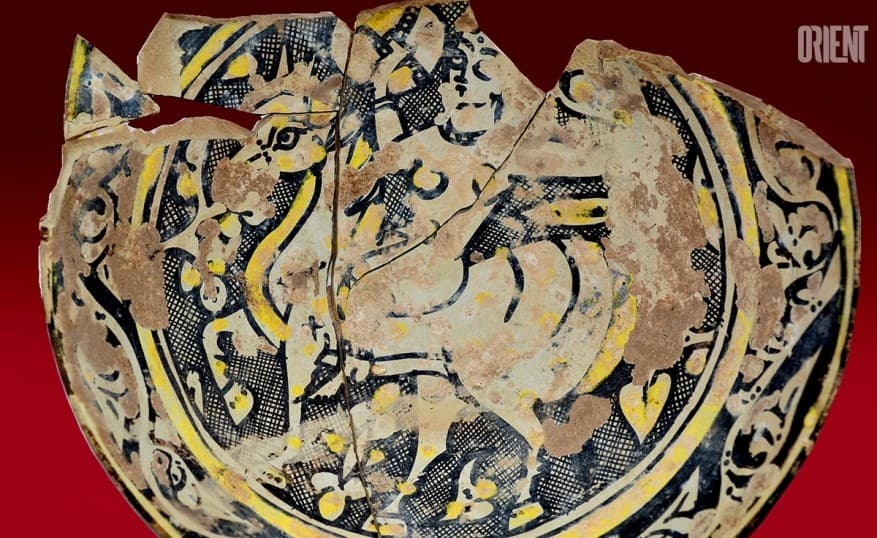
 A relatively intact irrigation bowl with black and honey-yellow paints on a white engobe stands out among numerous fragments of glazed ceramics found during excavations in Big Gyz-gala in Ancient Merv. The performance technique and the traditional motif of decorating the bowl edge in the form of a floral ornament enables to confidently date this product to the second half of the 9th-10th centuries.
 A winding stem-shaped pattern with semi-palmettes extending in free symmetry, from above and then from below, is known as islimi. It became the most popular in decorating works of various crafts precisely during the Abbasids Caliphate and reached a great degree of perfection in the era of the Great Seljuks.
However, an image in the round medallion at the bottom of the bowl is extremely rare in the ware ceramics of Merv, and Central Asia as a whole.
A depiction shows a woman riding a horse, where the picture was drawn with a confident hand in a clear line graphic that conveys the expression of both images. The horsewoman holds a highly raised round shield in one hand, the other, apparently, holds a sword. the faded out paint layer makes it impossible to see this part of the image, but the short blade of the sword is clearly highlighted in yellow, and even the fuller (a direct axis cavity) is shown on the blade with a black line.
A dish from Gyz-gala is characterized by transparency and purity of glaze, a contrasting color palette that creates a bright visual image. This is a completely unique example of the art of medieval Merv, an unusually holistic, plastically expressive product. Now it will adorn the collection of the Mary Velayat History and Local Lore Museum.
A winding stem-shaped pattern with semi-palmettes extending in free symmetry, from above and then from below, is known as islimi. It became the most popular in decorating works of various crafts precisely during the Abbasids Caliphate and reached a great degree of perfection in the era of the Great Seljuks.
However, an image in the round medallion at the bottom of the bowl is extremely rare in the ware ceramics of Merv, and Central Asia as a whole.
A depiction shows a woman riding a horse, where the picture was drawn with a confident hand in a clear line graphic that conveys the expression of both images. The horsewoman holds a highly raised round shield in one hand, the other, apparently, holds a sword. the faded out paint layer makes it impossible to see this part of the image, but the short blade of the sword is clearly highlighted in yellow, and even the fuller (a direct axis cavity) is shown on the blade with a black line.
A dish from Gyz-gala is characterized by transparency and purity of glaze, a contrasting color palette that creates a bright visual image. This is a completely unique example of the art of medieval Merv, an unusually holistic, plastically expressive product. Now it will adorn the collection of the Mary Velayat History and Local Lore Museum.
 The excavation results in Amul, the oldest part of the present-day city of Turkmenabat, are somewhat more modest. Amul emerged about two thousand years ago, when the entire fertile valley of the middle reaches of the Amudarya River was part of the Kushan Kingdom. The impressive cultural layer of Amul is to bring many surprises to the researchers, but for the time being, they have found ceramic jugs of the 19th century, a buckle from an old belt and a terracotta seal-amulet of the Kushan time with the image of a deer.
Such deer still live in tugai thickets along the Amudarya banks. The bowls imitating ancient Chinese porcelain confirm rather high workmanship of the medieval craftsmen of Amul. The finds include ceramic dishes with blue and light-blue glaze, fragments of glazed tiles of the same color, various metal and glass products.
The archaeological research results for 2019 will be announced at a conference on the study of the Great Silk Road monuments, and subsequently presented in a special book edition.
The excavation results in Amul, the oldest part of the present-day city of Turkmenabat, are somewhat more modest. Amul emerged about two thousand years ago, when the entire fertile valley of the middle reaches of the Amudarya River was part of the Kushan Kingdom. The impressive cultural layer of Amul is to bring many surprises to the researchers, but for the time being, they have found ceramic jugs of the 19th century, a buckle from an old belt and a terracotta seal-amulet of the Kushan time with the image of a deer.
Such deer still live in tugai thickets along the Amudarya banks. The bowls imitating ancient Chinese porcelain confirm rather high workmanship of the medieval craftsmen of Amul. The finds include ceramic dishes with blue and light-blue glaze, fragments of glazed tiles of the same color, various metal and glass products.
The archaeological research results for 2019 will be announced at a conference on the study of the Great Silk Road monuments, and subsequently presented in a special book edition.