Gender equality - on the agenda of Eastern Europe and Central Asia
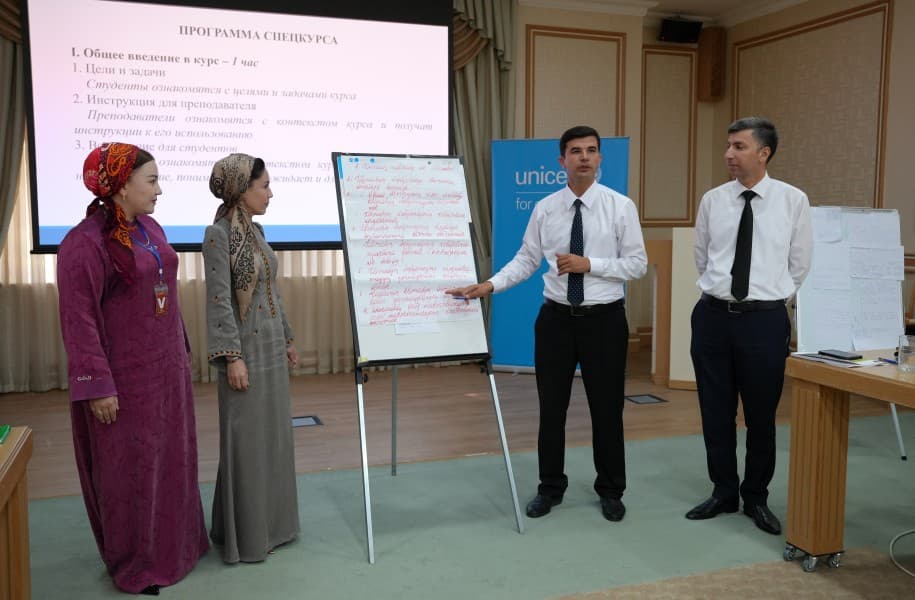
Member of Turkmen parliament Joragul Halbayeva has presented her country at the international meeting, hosted by capital of Moldova on 3-4 October. The event was devoted to gender equality in the Eastern Europe and Central Asia and the expansion of women's participation in all spheres of society and politics. Chisinau has brought together about 90 parliamentarians and representatives of civil society from Azerbaijan, Armenia, Georgia, Kyrgyzstan, Russia, Serbia, Tajikistan, Turkmenistan, Finland, Montenegro. The two-day regional conference "Parliamentarians for gender equality and women’s empowerment " was organized by the United Nations Development Program (UNDP), UN Women, OSCE Office for Democratic Institutions and Human Rights (ODIHR) and supported by the Parliament of Moldova and the Government of Sweden. The six sessions became a real dialogue platform for the exchange of best practices in promoting women's participation in political life. The participants shared their visions regarding the development of policies that take into account the gender needs of each group of society. At one of the sessions, representatives of the parliaments of Turkmenistan, Russia, Georgia, Moldova and Inter Parliamentary Union (IPU) described in detail the steps towards working out specific legal mechanisms to promote gender equality. In particular, ideas were voiced for setting up special committees and holding parliamentary meetings. The several sessions were held by representatives of the UN Women in an interactive format. The speakers from Armenia, Georgia, Tajikistan and Russia responded the questions regarding their experiences in arranging cross-party, parliamentary and cross-border cooperation, including strategic coalitions with men in parliament and with civil society. Today, on the final day, the partners summarized the work of the Conference during the debate on priorities for legislative and policy changes to further advance gender equality, women’s empowerment and achieve progress on the 2030 Agenda for Sustainable Development, namely, the SDG 5 "Ensuring gender equality and empowering all women and girls". The equal access for women and girls to education, quality medical services, labour opportunity and their involvement in political and economic decision-making will ultimately have a positive impact on the economic stability and progress of society and humanity as a whole. According to IPU, Turkmenistan is the leader among the Central Asian nations on gender balance in the parliament. In our country, women share 26% of seats in Mejlis, while in Kazakhstan - 21%, Tajikistan - 20%, Kyrgyzstan - 19% and Uzbekistan - 16%. In 2015, Turkmenistan adopted the National Action Plan for Gender Equality, which includes 15 goals and 60 activities. In the early years of independence, the country ratified the UN Convention on the Elimination of All Forms of Discrimination against Women. The women, leading in terms of employment, literally, are the driving force of progress in such areas as education, health and social services. They confidently realize themselves in politics, business and science.