



On the stage of the Magtymguly Musical and Drama Theater, the State Symphony Orchestra, under the baton of Principal Conductor and Artistic Director Rasul Klychev, presented a large-scale work – "Symphonic Pictures" – bringing together striking examples of Russian classical music.
The performance of the "Symphonic Pictures" program became a true journey through a world of musical images and colors, a series of vivid impressions, one after another, like scenes in a gripping feature film.
From the opening bars of "Three Miracles" from Nikolai Rimsky-Korsakov's opera "The Tale of Tsar Saltan," the orchestra seemed to open a fairytale curtain before the audience, and the entire stage seemed to come to life before their eyes. The symphony orchestra demonstrated not only the vivid imagery of the characters and their virtuosity, but also their mastery of contrasts: a filigree lightness in the squirrel scene, a powerful composure in the knights' march, and an inspired cantilena in the Swan Princess. The orchestra sounded incredibly lively and colorful, with emotional sincerity. You just wanted to sit and listen, captivated, enjoying this magical world with an almost childlike joy.
"The Prince and the Princess," the third movement from the "Scheherazade" suite, immersed everyone in a completely different world—oriental, enchantingly mysterious. The orchestra achieved a rare sophistication of sound. The strings sang broadly and soulfully, unhurriedly, very smoothly and carefully, creating a sense of light and peace—as if the music were enveloping the hall in a light, transparent veil.
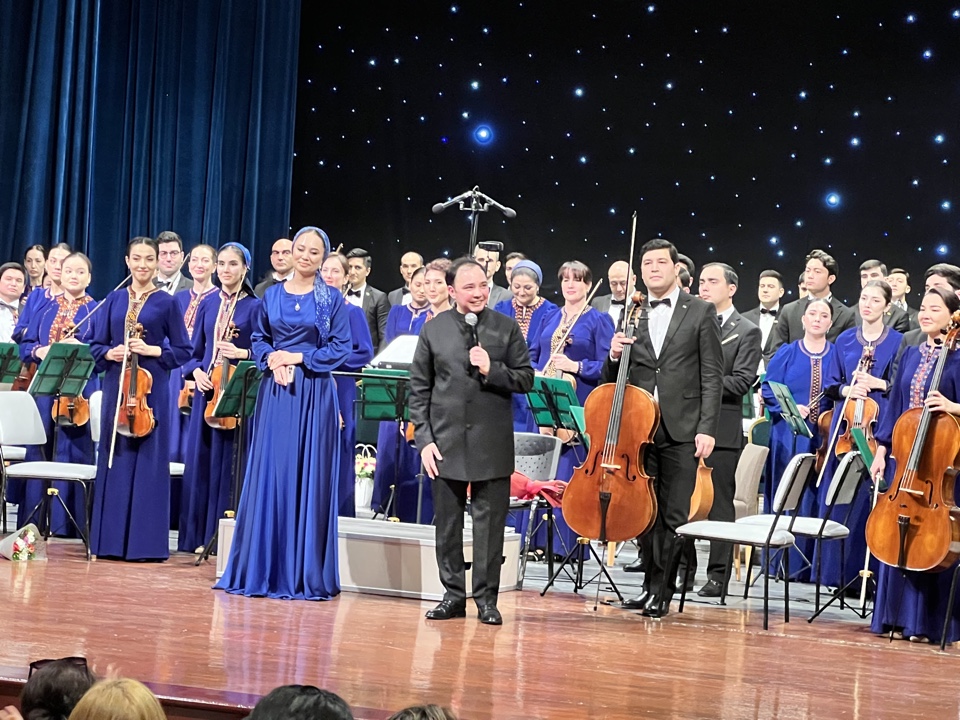
The clarinet solo, embodying the image of the Prince, performed by Yusup Ovezov, was particularly touching—soft, velvety, and very human. It was so tender and loving that the audience held its breath. The violin solo, embodying the image of Scheherazade, performed by Selbiniyaz Mulkamanova, with its capricious, oriental melismatics, responded flexibly and freely, as if it were not a written part, but a live improvisation. She sounded especially poignant. Her timbre seemed so warm and intimate, as if someone were telling an ancient Eastern story right then and there.
Anatoly Lyadov's "Baba Yaga" brought a lively and even slightly playful edge. The music developed rapidly, and the orchestra's passion was palpable. At times, it was enough to make you smile—the fairytale character's personality was so expressively and vividly conveyed.
The true climax of the evening was Modest Mussorgsky's "Pictures at an Exhibition," orchestrated by Maurice Ravel. Each movement unfolded as a standalone scene, and the overarching theme of "The Promenade" united the episodes into a single artistic whole. The concert performance highlighted not only the score's vibrant colors but also its inner philosophy—the artist's journey through impressions, memories, and reflections.
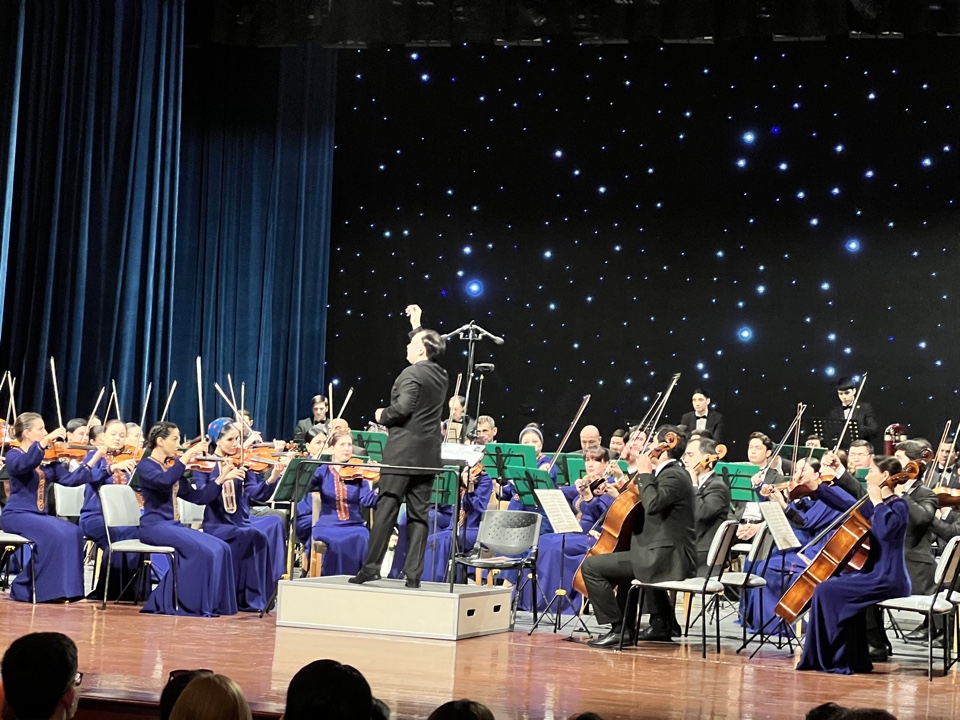
The contrasts within the cycle were particularly striking. All these picturesque, characteristic "pictures"—the pensive lyricism of "The Old Castle," the ponderous gait of "Cattle," the grotesque wit and fantastical quality of "The Gnome" and "Baba Yaga," the lightness and grace of "Tuileries" and "Ballet of the Unhatched Chicks," the impressive spatial effect of "Catacombs," and the majestic power of the monumental, apotheosis-filled finale of "Bogatyr Gates"—created a vibrant gallery of sound images.
The State Symphony Orchestra of Turkmenistan, under the baton of Rasul Klychev, demonstrated brilliant virtuosity, a subtle sense of style, mature interpretation, and impressive ensemble culture. The musicians confidently coped with both Rimsky-Korsakov's picturesque orchestration and Lyadov's vivid characterization, as well as with Mussorgsky's large-scale dramaturgy in Ravel's version.
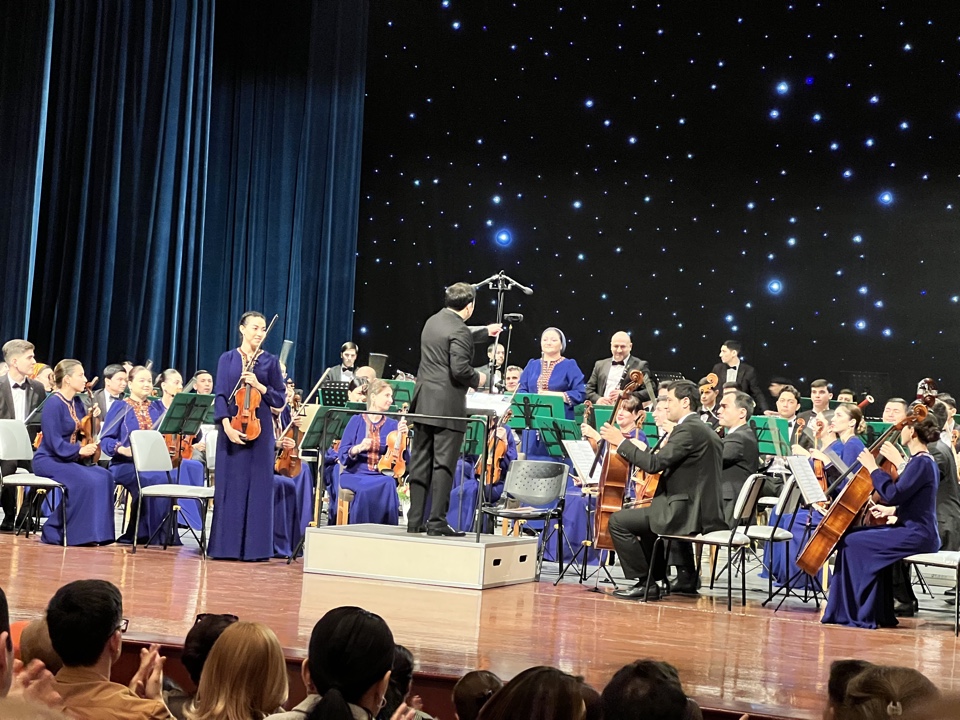
Each score revealed itself in all its beauty—from the subtlest lyrical nuances to majestic climaxes, invariably evoking a sincere response from the audience. The orchestra not only accurately conveyed the composers' intent but also imbued the music with a vibrant spirit, inner energy, and noble sound.
The concert was a highlight of the musical season, confirming the ensemble's high professionalism and its significant role in the country's cultural life. The thunderous applause was a well-deserved recognition of the musicians' skill and their dedication to the great tradition of symphonic art.
Svetlana KIM
