||
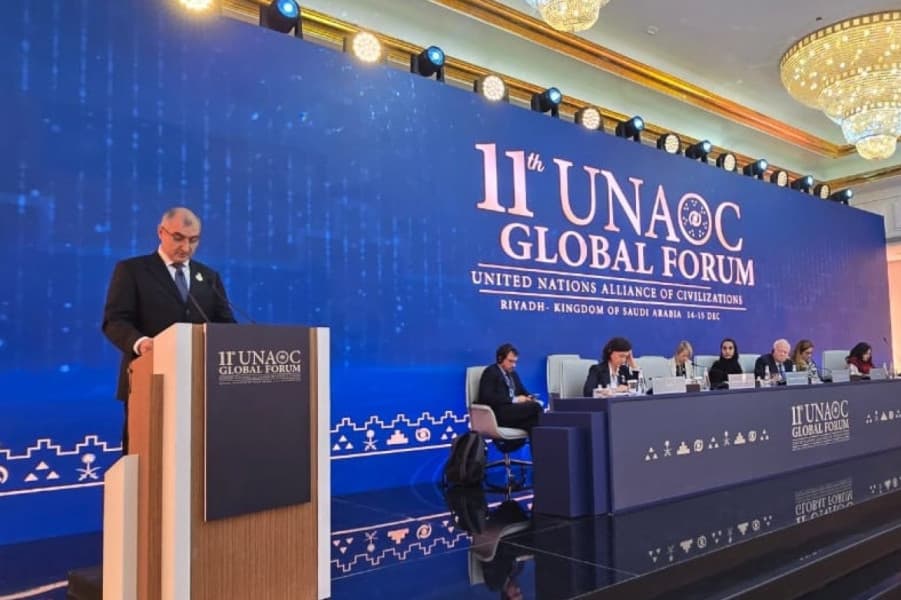
A delegation from Turkmenistan, led by Deputy Foreign Minister Akhmet Gurbanov, participated in the 11th Global Forum of the UN Alliance of Civilizations (UNAOC), which took place in Riyadh, Saudi Arabia, on December 14-15.
The forum, held under the slogan "UNAOC: Two Decades of Dialogue for Humanity: Advancing a New Era of Mutual Respect and Understanding in a Multipolar World," brought together representatives of governments, civil society, and youth leaders amid growing global polarization.
The summit, founded in 2005 following the tragic September 11 terrorist attacks, has as its abiding goal countering extremism and intolerance. As UN Secretary-General António Guterres emphasized in his opening remarks, diplomacy and cooperation are essential in today's era of fragmentation.
The UN chief described the paradox of modern times: as societies become increasingly interconnected, so too does fragmentation. He called a bridge between cultures the only path to sustainable peace, rejecting the path of "fear, walls of separation, and military escalation."
Turkmenistan's Initiatives: Overcoming the Crisis of Trust
In his speech, Deputy Foreign Minister of Turkmenistan Akhmet Gurbanov emphasized the increased importance of the Alliance of Civilizations amid the crisis of trust in international relations. He emphasized the direct alignment of the UNAOC's activities with Turkmenistan's initiative to declare 2025 the International Year of Peace and Trust.
In this context, Turkmenistan proposed specific initiatives to be implemented jointly with the UN Alliance of Civilizations, aimed at promoting a culture of peace and mediation, developing humanitarian and intercultural dialogue, establishing regional and youth platforms for peacekeeping cooperation, and strengthening trust and mutual understanding among peoples.
Ashgabat confirmed that its permanent neutrality serves as an effective tool for promoting "the dignified coexistence of people representing different cultures and faiths"—a key goal of the Alliance.
Following the Forum, the Riyadh Declaration (Riyadh Communiqué) was adopted, defining the next stage of the Alliance's development. The document identified the fight against all forms of religious intolerance as a global priority, and emphasized the key role of education as the foundation for the development of peaceful societies.
The Forum called on delegates, particularly youth, women, and girls, to advance the mission of Alliance with "courage, clarity, and hope," reaffirming that dialogue remains the only vital foundation for humanity.
ORIENT




 Chinese New Year