We are guided by what unites people




News
Articles
Media
Announcement
Technology
About Us
Contacts
In ancient times, when the stars still remembered the names of the first humans and the winds hid the secrets of ancient prophets, there lived on earth a righteous man named Ibrahim—the chosen one of Allah, a beacon of faith, and a model of virtue.
From his youth, Ibrahim gazed at the sky, asking:
"Who created these stars, the moon, and the sun? Who gave life to the earth and everything on it?"
His heart, pure as the morning dew, could not accept the idols worshiped by his fellow tribesmen. And so, they say, one night, when the sky was strewn with stars like precious stones on black velvet, Ibrahim emerged from his tent and said to himself:
"If there is an Almighty worthy of worship, it is the One who created all things. The stars fade at dawn, the moon wanes, the sun sets—then they cannot be gods. There is only One, the Eternal, the Almighty."
He began preaching among the people, saying:
"O people! Worship the One Lord, the Creator of the heavens and the earth! Do not associate with Him idols that neither hear nor see you!"
His words were like a spring in the desert—for some they became a life-giving source, for others a stumbling block. But Ibrahim, steadfast as a mountain, continued to spread the light of truth, reminding them that Allah is the same Almighty who hears the prayers of everyone who turns to Him with a pure heart.
…And then fate bestowed upon Ibrahim a great blessing, one that would determine the destinies of entire nations. God granted him two wives, and from each of them a son was born, who became the founder of a great nation.
The first wife, Hajar, gave birth to Ismail, a meek and pious youth. He became the forefather of the Arabs, whose name is forever inscribed in the history of Islam. The second wife, Sarah gave birth to Isaac, a wise and just man. He became the founder of the Jewish people, from whom many prophets descended.
Thus, two great nations, like two wings of a single bird, arose from a single root—the noble tree of Ibrahim. And although their paths diverged, the same blood flows in their veins, and the memory of brotherhood must live in their hearts. For Allah is one for all! And He is one for everyone who seeks the truth.
…But the trials of the righteous never end, and the greatest trial awaited Ibrahim. One night, when the moon was round as a silver platter and the stars flickered like candles in the hands of angels, Ibrahim heard the voice of the Almighty:
"O Ibrahim! Sacrifice your beloved son to demonstrate the strength of your faith!"
Ibrahim's heart sank as if struck by a dagger. He loved Ismail more than anything in the world, but he knew that God's will is supreme, and Allah's command is the law for the righteous.
The next morning, Ibrahim, his face pale as moonlight but his soul as hard as diamond, said to his son: "My son, I dreamed that I must sacrifice you. What do you say?"
Ismail, meek and humble, replied:
"My father, do as God commands you. You will find me, if Allah wills, patient."
They set out for the Valley of Mina, where Ibrahim had prepared everything for the sacrifice. The father's hand trembled, but the son's heart remained steady. And just as the knife was about to be raised, the voice of an angel rang out:
"O Ibrahim! You have fulfilled the test! God substitutes a lamb for the sacrifice!"
And instead of Ismail, a lamb with curly wool, as if woven from clouds, appeared on the altar.
And since then, it has become customary for people to celebrate Eid al-Adha – the Feast of Sacrifice. Not for the sake of blood and meat, but for the memory of loyalty and humility. This day reminds us of the strength of faith that endures trials. Of humility, which is stronger than pride. Of love, which submits to the supreme will of God. Of the mercy of Allah, who replaces sacrifice with a lamb.
May we not forget the true meaning of Eid al-Adha during the days of Eid al-Adha – not gluttony and feasting are important, but purity of heart, generosity of spirit, and the memory that all people are children of one forefather, brothers in spirit, if not by blood. And that God is one. He hears everyone who turns to Him with sincere prayer.
May the Almighty bless all who follow the path of goodness and grant peace to the hearts that seek the truth!
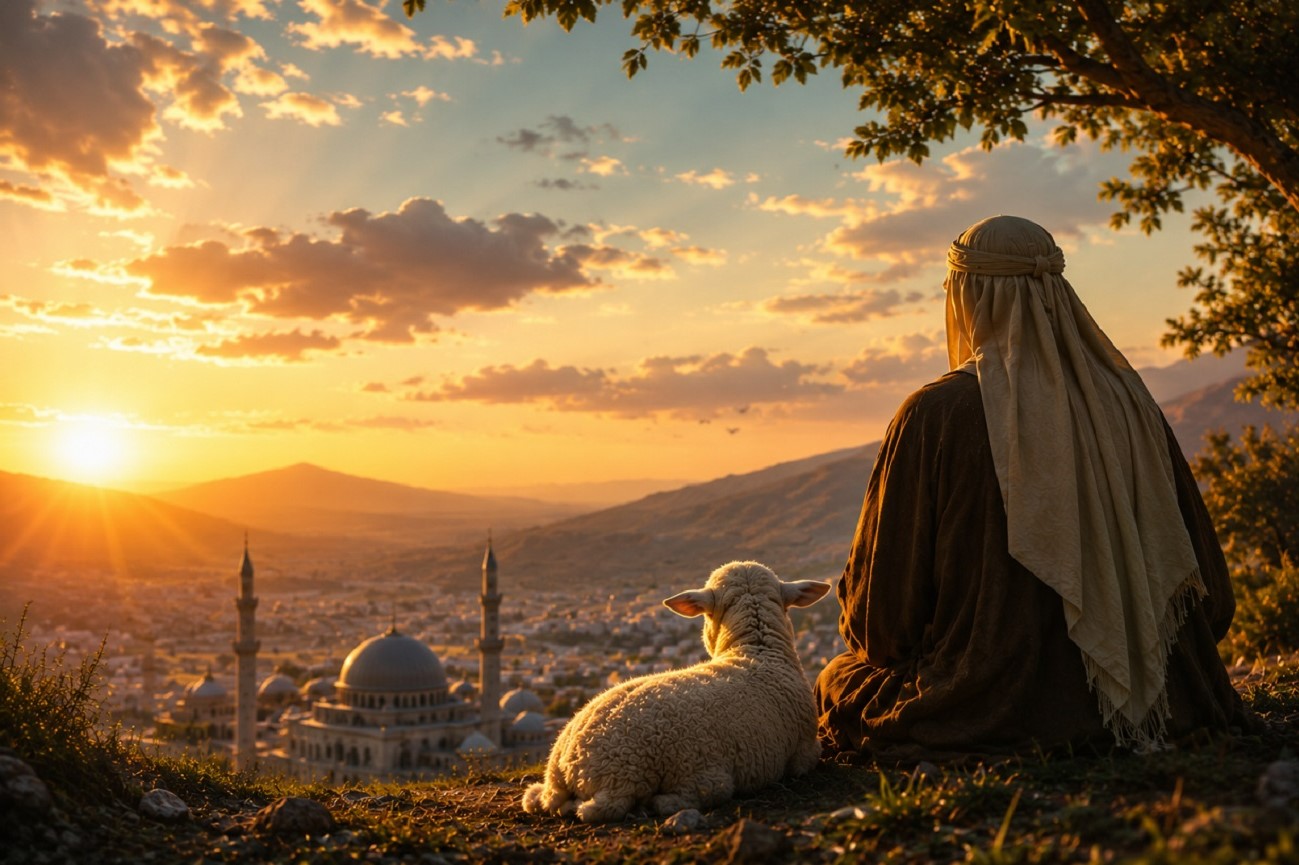
The story that forms the basis of the Feast of Sacrifice is revered by millions of people worldwide. However, over centuries of literal adherence to rituals, the true, profound meaning of this legend has often eluded the superficial eye.
Our retelling of this ancient parable is an attempt to free it from its superficial, external cult and reveal its true philosophical and moral foundation.
After all, this story is not about the shedding of blood or blind, fanatical obedience. It is a tale of the greatest humanism—of that moment in the distant past when the Creator forever forbade human sacrifice, proclaiming the sacredness and inviolability of human life.
In a world where faith sometimes divides people, this legend, on the contrary, serves as a reminder of our common God, no matter what we call Him. This is a parable about shared moral commandments.
But most importantly, it shows that true love for God is measured not by the price tags of the gifts offered, but by purity of heart, mercy, and the capacity for self-sacrifice for the sake of the world and one's neighbor.
Bekdurdy AMANSARYEV
